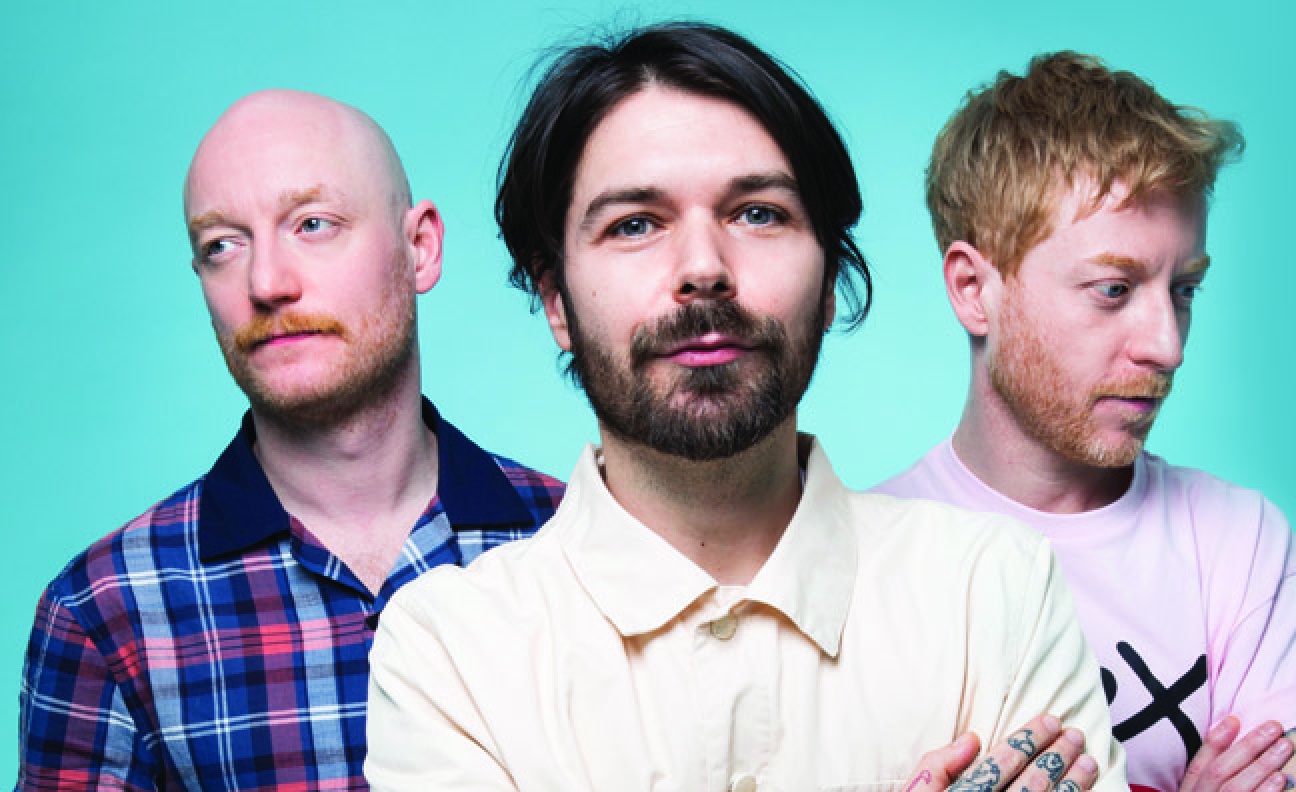
Next month, Biffy Clyro release their incredible eighth album A Celebration Of Endings – the latest chapter in an extraordinary journey that’s taken them from indie label hopefuls to festival-headlining global stars. Music Week joins Simon Neil, James & Ben Johnston, manager Paul Craig and Warner Records’ Phil Christie to find out how, contrary to their new record’s title, this is just the beginning for them...
There are two Simon Neils in this story. The first Music Week encounters at Warner’s London HQ back in March, 2020. Flanked by his bandmates, brothers Ben and James Johnston, this incarnation of Biffy Clyro’s singer/guitarist is revealing the inspiration behind the band’s excellent new album A Celebration Of Endings, ahead of its then-slated release of May 15.
“Every other record’s been about loss, love or how I feel about things,” says Simon Neil. “This is the first time I’ve written lyrics from a macro perspective, rather than just my micro position. I feel I’ve been forced to write these new songs.”
From there, the frontman outlines his disdain for a world in which “compassion, empathy and things that should be part of everyone’s foundation are now up for debate”. One in which Greta Thunberg is bullied by “70-year-old white men” for wanting to save the planet.
“I’ve felt depressed for the last four or five years,” he explains. “It’s not just me, it’s getting everyone down; I just feel we’re at the point where that generation, not to sound horrible, just need to fucking shuffle off this mortal coil. I’m like, ‘Fuck it, we can take the stuff we learned from the past and build upon it – not everything needs to be fucking kept the way it was, not everything that happened in the past is valuable.’
“But I’m actually feeling quite positive right now,” Neil adds. “I feel we’re hitting the lowest point in order to bounce back up…”
The second Simon Neil we encounter on the phone, three months – and one global pandemic – later. “I’m sure I said things can’t get worse,” he laughs, from his home in Scotland. “Little did we know!”
His former words about not everything in the past being valuable, in particular, resonate with recent months that have seen statues ripped from their bases. Biffy’s frontman is, he says, filled with hope for the future, especially after seeing the global Black Live Matter protests. While he denies clairvoyance, Neil does believe there’s a sense in which Biffy’s new songs chime with a year in which a lot of headlines dealing with politicians “could have been written by Chris Morris or Armando Iannucci”.
Having been postponed due to Covid-19, A Celebration Of Endings is finally due to arrive on August 14. It is a towering work, one pushing Biffy’s sound into bold new places. Bassist James Johnston speaks with almost holy reverence as he recalls beings on his “hands and knees with emotion” as they entered Abbey Road’s Studio 2 to record The Champ: a stunning song uniting them with a 30-piece orchestra...
It’s but one standout of many on an album hailed by Biffy’s manager, Paul Craig (Nostromo management founder/MMF chair), as “one of the very, very, very best Biffy records ever”. Warner Records president Phil Christie agrees, not only calling it “spectacular” but also labelling Biffy as “one of the most important British rock bands of recent times”.
None of which drummer Ben Johnston can comprehend right now. During lockdown, and between valiantly failing at his objective to learn French, his mind’s been playing tricks on him.
“I’ve lost all perspective,” the drummer laughs as we interrupt him at Biffy’s rehearsal space in July. “I’ve started to question if I’m even in a band. I’m looking at a photo of us headlining Reading right now, like, ‘Did we do that?’”
They did. And much, much more besides. Seems like the perfect time to celebrate not so much endings but, rather, one of the most incredible journeys in modern music...
Rewind to March, 2020. Biffy Clyro are laughing their arses off at Warner’s HQ. Your correspondent has just told them about his first time encountering Biffy Clyro live, back when they were supporting Hundred Reasons at Nottingham Rock City in 2004. That night they often played with their backs to the crowd, or else facing each other. Simon Neil was wearing a scarf. A big scarf. A scarf so big it could even have been described as confrontational.
“I remember that, it was big enough for three people,” laughs Ben Johnston. “It was enormous.”
“What a reputation!” hoots Neil.
Were Biffy Clyro already brilliant at that time? Yes, absolutely. But did they seem a band pre-destined for major label success and headlining festivals? No. And this is not lost on them.
“It is crazy to me, man,” says Ben Johnston. “We never thought we’d even get to make an album or even get to play [Glasgow’s] King Tut’s Wah Wah Hut. That was the dream: if we ever got there we could retire. I don’t know how it happened. We didn’t set out to be super-popular. We always liked our music, we never thought this many other people would like it as well.”
“There were almost two thoughts running at the same time, though,” adds James Johnston. “We wouldn’t have been scribbling imaginary Reading line-ups with us at the top on our jotters at school if we didn’t want it to happen, or believe in some small way that it might. But you could never have predicted it...”
Biffy Clyro first emerged into the world as an independent group signed to Beggars Banquet: their first three albums – 2002’s Blackened Sky, 2003’s The Vergito Of Bliss and 2004’s Infinity Land – winning them critical acclaim, but scant commercial success. And they were over the moon.
“For us, our idea of success was at such a low level,” grins Neil. “It really helped us because the naivety just meant we weren’t ever thinking, ‘Why is no-one listening to this album?’ We were like, ‘There’s 20 people here who fucking know every word!’”
Relentless touring played a big part in forging their legend – Ben likening them to a Trojan Horse who infiltrated rock by playing every show and festival they could, just waiting for bigger bands to pull out so Biffy could usurp their slot last minute and blow the crowd (and promoters) away. Gradually, however, things changed.
“We realised that there were almost two different music industries,” explains Neil. “There are bands that go out and it’s about the show, music and reaching people. And then there’s the business. We didn’t feel a part of that until we moved to Warner.”
It was while grieving the death of his mother that Simon Neil penned songs that would take Biffy Clyro to the next level.
“When my mum passed away in 2004, that made me take our music a little more seriously,” he says. “I realised the songs I was writing at that point felt more important than any music I’d ever written and I really wanted to represent it properly. I’d already written Living Is A Problem... and Folding Stars and, suddenly, our ambition for the music had outgrown the label. I don’t know how to say this... I just think on Beggars at that point, we’d plateaued out.”
Of course, many is the rock band who have signed with a major only to be dropped before the ink has even dried on the contract. Yet from the moment the band’s platinum 2007 major label debut Puzzle arrived, the Biffy x Warner partnership has gone from strength to strength – James Johnston praising the label for never trying to change them. President Phil Christie, who also worked on the album in an A&R capacity, hails the relationship as one of mutual respect and understanding, heralding them as “one of the most experienced artists I’ve ever worked with in terms of their process”. And this has much to do with their indie roots…
“I remember on our second album discussions at Beggars were like, ‘If you’ve got a single, we’ll put it out, if you don’t, we won’t’,” recalls James Johnston. “So right from early on, there was that separation between, ‘We’re going to make the music’ and, ‘You’re going to make the choice as to whether there’s a single, and potentially what song it is.’ It means you’re not going in to make an album saying, ‘We need three singles!’ We just don’t have that rattling around our heads.”
“The fact that we were left to our own devices for three albums meant we knew what to defend and cherish when we were on a major,” agrees Neil. “We knew to value the right thing: which was to protect the music. We’re happy to go play here and there, have a laugh, do a shit ton of interviews, but the music remains untouched. We create it all and then it’s like, ‘Right, this is what we’ve made – if you think there’s a single, great! But this is the album we’re making’.”
And oh how it has worked. Biffy’s last two records, 2013’s double album Opposites and 2016’s Ellipsis both entered the charts at No.1, while 2009’s Only Revolutions is now double platinum, having sold 796,119 copies according to Official Charts Company data. This is to say nothing of their track Many Of Horror being improbably covered by Matt Cardle as The X Factor winner’s single in 2010. Their pedigree as a live act is, arguably, even more impressive, having headlined Reading & Leeds Festival twice, plus Download, Isle Of Wight, Trnsmt, Sonisphere and Bellahouston, as well as playing Glastonbury multiple times and being selected by MTV to perform the channel’s first UK Unplugged set in 20 years. But for manager Paul Craig, what’s most extraordinary is Biffy’s marriage of talent and their indefatigable drive.
“You get sports people and artists who have a really great two or three years, right?” begins Craig. “They burst on the scene and then people go, ‘What happened to them?’ Sometimes it’s not to do with a lack of talent, it has to do with the fact that once they get to a certain position, they lack the drive, determination and ambition. It dilutes. With Biffy it doesn’t dilute. I remember when they headlined Reading & Leeds the first time, they wanted to smash it not just out of the park, but smash it so far out you could never see it. We always said being invited to the party once is great, but the real sign of success is that you’re invited back. They’re still ambitious, still pushing the boundaries and building their career.”
Which brings us back to A Celebration Of Endings...
Sometimes, when it comes time for Biffy to write a new album, Simon will turn to Ben and James. “I might not have any more songs left, boys,” he says.
“We’ll just say, ‘Aye’,” smiles James Johnston. ‘Aye’: the communal sound of two brothers who know that he always has more songs. Paul Craig, for one, believes Biffy’s frontman deserves an Ivor Novello. “Very few songwriters can write the variety of songs, and the quality of songs, that Simon can,” he reasons.
“Simon just can’t switch off, and I’m sure that haunts him to a degree,” says Ben Johnston. “But it’s great for a band.”
Indeed, one of the most under-celebrated aspects of Biffy’s career is that each album has its own attendant B-sides record of A-side quality material (check out 2014 record Similarities). When Celebration... arrives, the group will have released a staggering 196 songs since 2002. Oblivious to this feat, they crack up when they hear that number. “You’ve basically got two ideas you’ve done nearly two hundred times, Simon!” mocks, er, Simon Neil.
This is a band whose definition of a year off in 2019 involved recording a soundtrack album of original Biffy music, Balance, Not Symmetry, and an MTV Unplugged tour. Make no mistake, however, lurking behind this deluge of quality material is a band driven by a deep-rooted fear of stagnation.
“The first question is always, ‘Why are we making this record?’” says Neil. “It shouldn’t be, ‘Alright, it’s time to get back in the studio’. I need to feel I’m putting something on the line, whether it’s a reputation or a part of myself I’ve kept hidden. The fear gives it value; otherwise it’s just a ‘thing’, you’re just making lunch. And we don’t want to just
make lunch.”
You need only compare and contrast two songs on Celebration... to see that Biffy are most definitely not making lunch. The first is keyboard-led lead single Instant History which is Biffy as you’ve never heard them before.
“Someone said ‘EDM’ when they heard it and I almost spewed, I was like, ‘Oh no!’” jokes Neil, sticking two fingers into his mouth. “Bluuuuurrgh!”
Don’t let that simulation barf fool you. The band love it.
“Change is not the easiest thing in the world,” reasons James Johnston. “Yes, there’s a bit of trepidation, but you want to feel a bit nervous about what you’re doing.”
Their decision to lead with Instant History – whereas previous campaigns focused on riff-centric tracks – is revealing.
“It was a move that spoke to the international ambition of the project,” says Phil Christie. “We wanted to give a first statement that could work globally both at radio and at streaming for as many territories at once. We all felt
super-confident about it.” Already hailed as Hottest Record In The World on BBC Radio 1, Instant History has since passed five million streams on Spotify alone.
“The thing that’s eluded them is a significant global streaming record,” says Christie. “They’ve had hit singles, but not in a consumption landscape. What I mean is a song that doesn’t get ghettoised as a rock record by editors. That’s a challenge for all rock bands.” A Celebration Of Endings may just contain one, however, with Christie pointing to the beautiful crossover ballad Space. With all of that said, don’t think you have this album pegged...
At the other end of the spectrum is Celebration’s closer Cop Syrup – a caustic punk song that suddenly turns into an elegant classical string section before erupting violently once more. Its final lyric? ‘Fuck everybody! Wooooooooo’!
“I originally wanted to put that song first on the album!” grins Simon Neil. “I love unsettling people. I don’t want us to be an easy fit where you see our picture, hear one song and you’re like, ‘I know what the album’s like’. I like being misunderstood, there’s a comfort in that. I would feel uneasy if people really ‘got’ our band. As much as I want people to feel comfortable when they listen to some of our songs, I want to make a few people feel really unsettled. We’re like, ‘Enjoy Instant History and Cop Syrup!’ We ask quite a lot of our fans.”
As for how they’re getting the album to fans? Well. There was, of course, a plan in place. The Celebration… campaign started off with top names from the media world arriving at Warners for personal playbacks to light the fuse with “word of mouth” buzz. What’s happened since has been, in Paul Craig’s words, “Different, unique, unprecedented, stressful, testing, emotional. All those things and many more.” Enter: Covid-19. “It’s very difficult to launch an album for the greatest live band in the UK when you can’t play live,” Craig deadpans. “That’s been a challenge.”
During the lockdown, Craig’s friends often got in touch to give him updates of what they had achieved. “I’ve painted a wall!” they would say. Craig, however, has had his retinas glued to his email from 7am everyday trying to tee-up for Biffy’s new August 14 release date.
“We totally pivoted our campaign,” says Craig. “I don’t think I’ve used the word pivoted so much in my life. I don’t think I’d used it before. It became an incredibly different campaign in a very different world.”
Craig outlines Biffy’s lockdown activities. The list is extraordinary. There’s been livestream Facebook/YouTube live sessions (reaching more than 1m people), plus the Johnstons doing Instagram live chats, fan Q&As and tutorial videos. Then there was the home-recorded video for single Tiny Indoor Fireworks and a BBC Radio 1 Big Weekend virtual live performance. Oh, and there was a No.1 single to their name via BBC Radio 1’s Stay Home Live Lounge Allstars cover of Foo Fighters’ Times Like These – the group appearing alongside Dave Grohl, Dua Lipa, AJ Tracey, Chris Martin et al. This was in addition to their Mon The NHS merch range which raised money for NHS Charities Together, plus Simon’s acoustic set for Twitch’s Stream Aid 2020. Nope, the list isn’t done yet. Simon also took part in the Formula 1 Esports Virtual Canadian Grand Prix – appearing across F1’s YouTube, Twitch, Facebook channels as well as Sky Sports, BBC Radio 5 Live, and a video call with F1 driver Daniil Kvyat. All of this on top of doing Instagram and Facebook live interviews, Q&A sessions and Zooms with press. Here it should be stressed, two members of Biffy Clyro don’t even have Twitter accounts. The overall picture is of a band working harder than ever before.
“I think people expect groups and artists who’ve been going a fair few years to basically dial it in,” says Craig. “Let me tell you, the west coast of Scotland boys I know don’t dial anything in.”
Hell, Simon Neil confirms he also has two other projects on the go: a doom metal band called Tippy Toes and a math-metal group called Empire State Bastard who plan to release two debut albums at the same time. As for Biffy? They’re already plotting their ninth outing. “The next record we do is going to be the carte blanche one,” says Neil. “We’ll just throw everything at it and make the most crazy thing ever.” But before that, let’s celebrate their incredible story some more...
What does A Celebration... mean to you personally?
Simon Neil: “I’m so proud of it. I want people to feel like it’s one of our best records because that fucking matters. It still fucking matters. We’re realistic enough to know that after you’ve made eight albums, nobody’s sitting around going, ‘Hmm, I wonder what their eighth album will be like?’ There’s an element of, ‘I’ve probably got my favourite Biffy record’. Our job is to make sure our new album is your new favourite Biffy record.”
James Johnston: “Most of our favourite bands only made two or three records so, in a strange way, we feel we owe it to them.”
Ben Johnston: “I do think it’s our best, and I don’t think I always say that… I’m pretty sure I don’t always say that! With this one, we’ve taken everything we’ve learned over the years, it’s almost like all our albums mashed into one. It’s us showing all of our colours. I couldn’t be more proud.”
Would the slow-build growth that proved so crucial to your current success still work for new bands in 2020?
SN: “I don’t think anyone would have the patience for that. Even with us, we would look for a faster result because of the nature of the world now where things happen a lot quicker. I know how hard it is for rock bands that did things the way we did, which is to go on the road and fucking make sure people don’t forget you. If you want to get your mug on the TV, it’s probably not the easiest way to go about it. But we learned who we were as a band by touring and we grew with the crowd that continued to see us. I don’t think that patience is necessarily there these days. Bands need to grow. Not everyone has a fucking team of folk behind them that make their music and tell them how to look.”
JJ: “I’d like to believe it would still work, but I’m not convinced. Even some of the bands that came five or 10 years behind us, and maybe in some ways looked up to us, I feel that they’ve taken the wrong message from what we’ve done. They’re trying to look at our career trajectory and repeat that in some ways, and I don’t think people should be too concerned about that. Everything’s changing in the way your career can go. We never worried about that aspect of being a band. We just tried to make the best songs we could.”
Many of the indie venues you grew in are also under threat…
SN: “If venues disappear, we’re losing a generation, if not more, of talent. Be it a hip-hop star or a rock band or an electronic act, that’s how the next generation blossom. If the government doesn’t get it right, we’re losing one of the UK’s most valuable assets. The music that comes from this small island is, across the board, astounding. There’s generations of kids that are going to lose opportunities from study to job opportunities, we cannot fucking rip the culture away from them as well. All they have is this expression. Yes, airlines are important, but should they get bailed out before the fucking culture of the country? No, I don’t think so. The government [have been] treating it like a leisure activity, like it’s a fucking hobby or something. This is a defining characteristic of our country. One of the few things to admire about our country is the culture and most of these fuckers in the government won’t have been to a gig or a show ever. Maybe Gary Barlow doing an acoustic performance for a charity and that’ll be the closest… They did not see Eyehategod at the Limelight in Belfast! But they need to. That’s the fucking problem. The government are saying, ‘We can have the crowd six metres away’ and ‘band members three metres away’ – are you fucking joking? Have you ever been in a venue? If everyone’s playing an arena, maybe!”
Both on and off the record, you’ve been candid about the ups and downs of life as a musician. Does the industry do enough to protect its artists?
SN: “The record industry is a bottom line industry, the same as any other: it’s about money. You, hopefully, are lucky to have good relationships in it. When bands get dropped by their label, no one’s phoning them two weeks later saying, ‘How are you doing?’ That could be addressed because that’s a form of grieving. I’ve known people that have been dropped and it’s horrific: it’s your entire livelihood and sense of being. It can go from people telling you ‘This is amazing!’ to two weeks later, ‘Turns out it wasn’t amazing at all’. There’s kids being brought into the music industry at 19/20 years old in this day and age, lots of young singers that are getting flung into the deep end and six months later, everyone hates them. How do you address that? I don’t have a solution for the record companies, but they need a support network. You’ve got to be tough in this world and it’s not fair because sensitive souls just don’t get looked after, and they need to be taken care of. There’s no escape for some of these people, they just feel so caught up in it, and there’s no separation of real life and work now. I don’t have a personal Twitter or Facebook to protect myself from that. I know that I couldn’t draw a line to separate it. It would get me down.”
BJ: “You have to surround yourself with good people that care for you. That goes as far as your manager, the label, they have to care for you as an individual, not a cash cow. They can’t just keep sending you out to do more promo and gigs when you’re clearly exhausted mentally. A lot of artists get physically and mentally rinsed. We do tour hard, but we have our balance. We didn’t at points. We hit the wall before. We’ve fallen out, which is unheard of for us. It was just mental exhaustion. We hit a wall and had to come home. What was the lesson? Not to stay on the road forever [laughs]. After that happened we put it in place where we’d only be away for six weeks at a time and then go home for a few days. That’s what we live by. We’ve got those little stipulations for touring just because we know what happens, man. It’s there for all to see. If you don’t look after yourself and put parameters in place, then nobody else will and then you will get walked over and hit a wall.”
Looking back, what did The X Factor do for your career?
SN: “I think we were lucky. I had belief in the song, I remember when I wrote it I said to the boys, ‘This is potentially the best song I might ever write’. I wasn’t worried about our reputation because we’re a fucking band that does our thing over here and if someone wants to sing our song over there, that’s fine. Looking back now, 10 years on, for better or worse, it elevated our music to a wider consciousness. It did work out for the best, but we were very aware that that wasn’t the kind of band we wanted to become. It was because they were like, ‘We love your song, can we use it?’ I was like, ‘Fuck it, aye, that would be quite funny!’ It’s almost miraculous that it worked. But also, in that era, X Factor covered Heroes by Bowie, Hallelujah by Leonard Cohen, so I feel there was a wee period there where they were choosing good music. Whoever was picking those songs for that couple of years, good job! Three of the best: Bowie, Biffy and Leonard [laughs].”
Finally, what is success to you at this point? Is a No.1 important?
JJ: “There’s different levels to it. We’re really happy with the music, but there’s more to the debate because we also didn’t just make it for us!”
SN: “You’ve nailed it. To say no would be a lie. When Ellipsis went to No.1, I couldn’t quite fucking believe it. I was absolutely over the moon. If this album didn’t go to No.1 we’d be disappointed, yes, but we’ve not made the album to go to No.1. There are two different successes. Your artistic success is not really relevant to your commercial success, because if it was, then most of my favourite albums would be the biggest albums in the fucking world. So that’s where we make the split. We’ve succeeded with the album, the other success is now on the work side of things. The art always remains untouched by the pressures of the job.”
 FOLLOW