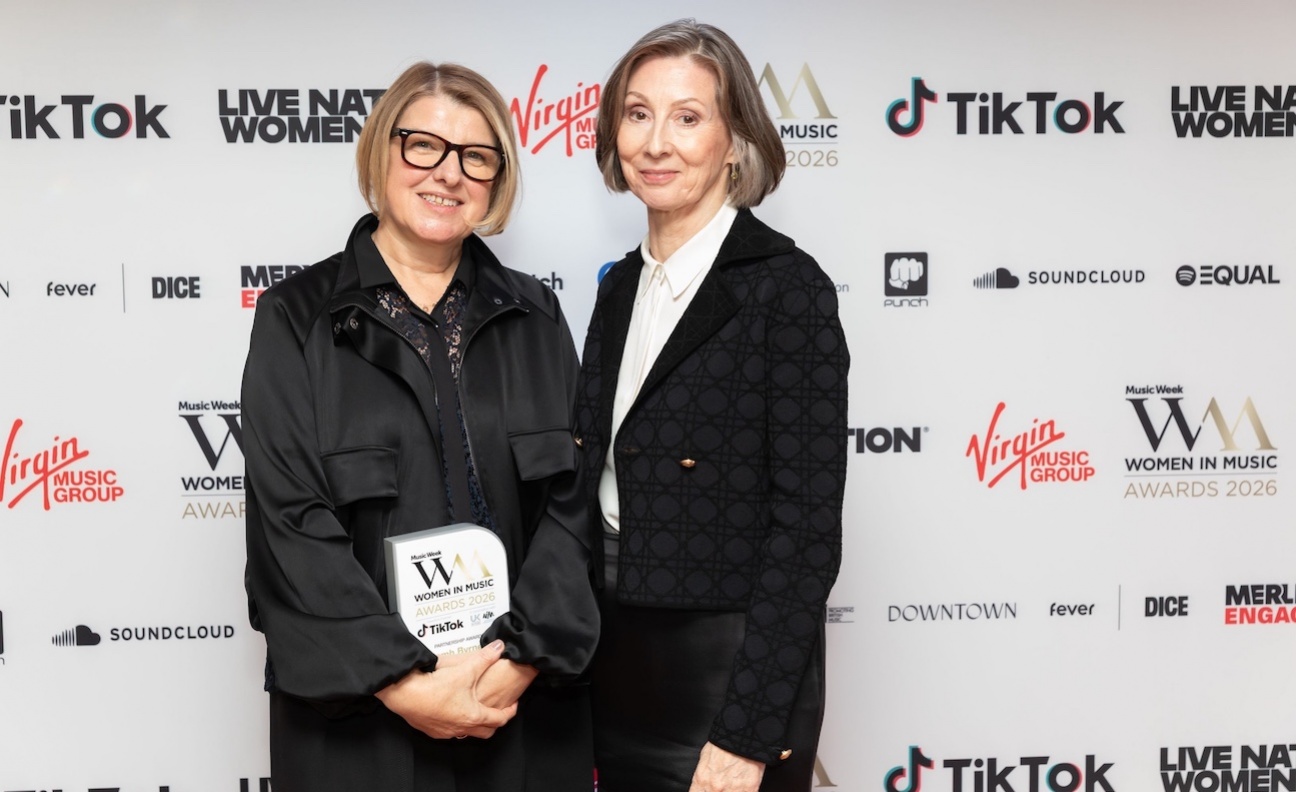
At this year's Women In Music Awards, we celebrated the achievements of game-changing executives and artists as the industry came together to honour their work. Music Week has spoken to the winners in all 14 categories to tell their stories. Here, we sit down with Eleven Management’s co-founders & directors, Niamh Byrne and Régine Moylett, to look back on their journey and achievements to date.
Interview: Charlotte Krol
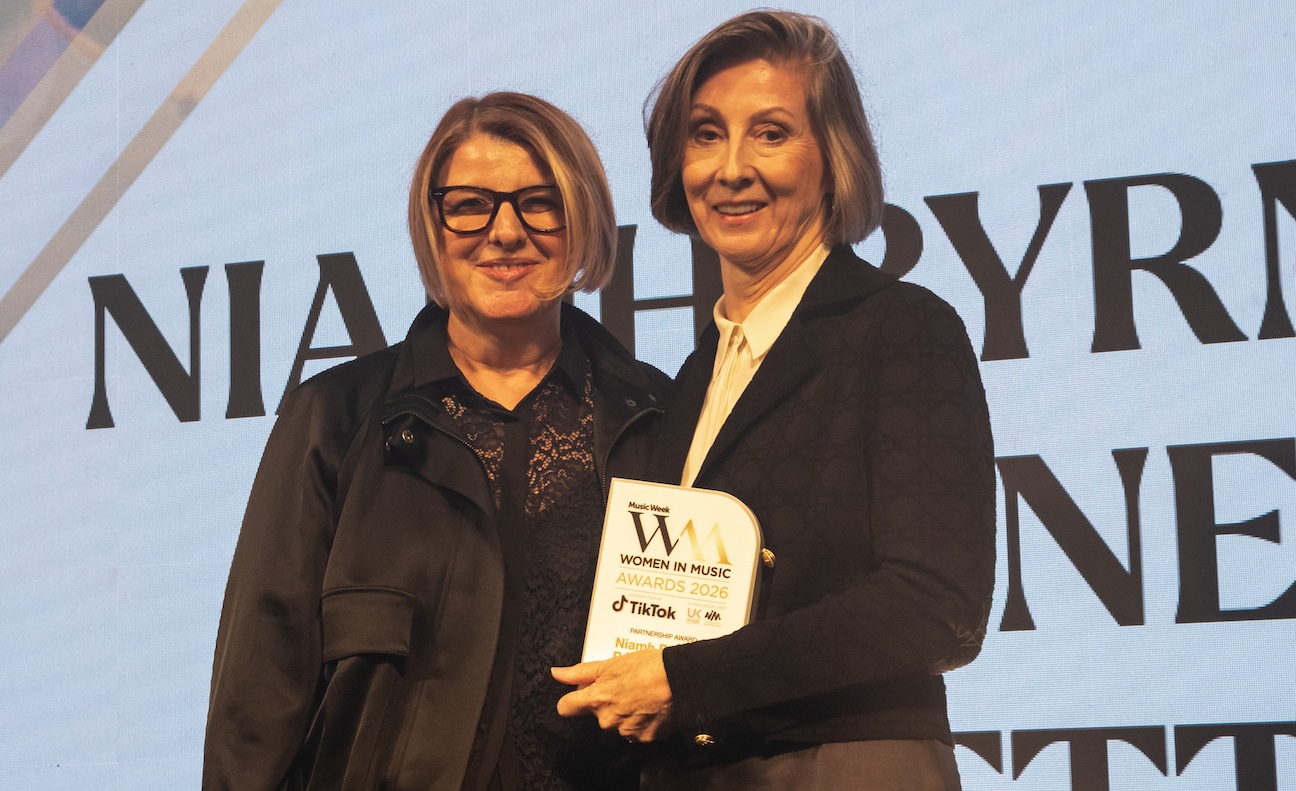
Eleven Management’s Niamh Byrne and Régine Moylett are the winners of the inaugural Partnership Award. The dynamic duo founded the music management company in 2011, its roster of which includes Damon Albarn, Blur, Gorillaz, Jamie Hewlett, Bastille, The Clash, Bashy, Riz Ahmed, Naomi Scott, and many others.
Between them, Byrne and Moylett have worked in music in different capacities for more than four decades. The Dublin natives first linked up when Moylett was brought on to do Blur’s publicity and Byrne was working as the band’s day-to-day manager.
Both women were well-established in the industry before the idea to form a management company together came about in 2010 when Gorillaz were promoting their third album, Plastic Beach.
“It was a case of the clients coming to us and saying, ‘Can you do this for us?’ rather than us deciding to go into partnership and look for clients,” explains Moylett.
Byrne previously worked for more than 15 years in management, on Blur, Elastica, The Jesus & Mary Chain and Turin Brakes, before she started her own consultancy company, The Engine Room. There followed several years as a consultant at UMG UK, in which she pioneered the Music Matters anti-piracy campaign and led the redesign of the BRIT Awards. This year, she continues her stint as chair of the Music Managers Forum (MMF), having first joined the organisation as a board member in 2022.
Moylett, meanwhile, served in publicity at Chris Blackwell’s Island Records before founding her award-winning boutique publicity company, RMP, which remains in operation today.
In 2017, Byrne and Moylett received the Entrepreneur honour the Artist & Manager Awards.
“A partnership award hasn’t really been done very often, and it’s a really great thing because there are lots of people who work together as duos,” Byrne reflects of her and Moylett’s Women In Music Awards triumph.
She points to what is perhaps an unexpected “key" to their success” which is that the pair generally hold differing opinions.
Moylett, ironically, agrees: “Oh, we're completely different. We disagree on everything.”
To hear more about just how that friction works in practice, we sit down with Byrne and Moylett to learn about their working relationship, their recent independent music success with Gorillaz, the hurdles women faced in the industry 30-plus years ago, today’s challenges, and how they relish every opportunity to overcome them….
First of all, congratulations on winning the brand new Partnership Award. How does it feel to win and to be the first to do so?
Niamh Byrne: “Winning an award that specifically celebrates a partnership is great. It reinforces the value of collaboration, of shared vision and teamwork. I'm really pleased to be receiving the first award of that category.”
Régine Moylett: “It’s amazing because we're not people who are putting ourselves up for awards. We represent other people who win awards. Fortunately, Niamh and I have been very lucky, winning a couple of awards since we started out. It's so unusual for us and it's so unexpected. To be perfectly honest, I don't really know how to react to it, because it's so outside of what it is that we do. Obviously, it's an amazing thing to receive. We frequently celebrate between ourselves the fact that there's two of us, because it makes it much easier.”
What is the key to your success as a duo?
NB: “We complement each other due to our differences. A great partnership is when you fill each other's gaps. I don't think it works if you're both exactly the same. It’s about celebrating those differences.”
RM: “Yes, and the [other] key to success is that we speak precisely the same language. We’re both from Dublin, so we communicate really well, but we disagree about everything. What happens is we both enter into something, one of us will reverse out of it and look at it from the other side. To an outsider, it might look spiteful, but between us it's like, ‘Oh, I'm really glad you did that, actually.’”
NB: “There’s a healthy friction. And to Régine’s earlier point, we do speak the same language; it's very free. Generally speaking, we talk things through and interrogate options. Usually, we end up with a better solution.”
Artist management has changed hugely over the years. What do you think represents the biggest challenges to managers in 2026?
NB: “So much has changed. The biggest challenge – which probably comes with being chair of the MMF, and is something a lot of managers talk about – is that we're no longer just guiding record releases anymore. For most of us, we're running global, multi-platform media companies. We have to become live event producers. We have to be experts in digital operations. That’s obviously challenging logistically and financially, but it's really rewarding, too. I do believe we are best positioned to do that for an artist and can serve their needs better. Operationally, it brings more hurdles for managers because you need, essentially, more time in the day and more expertise to be able to do it all. It’s also very hard to make money in the same way as before.”
You've achieved huge successes at Eleven. What are the cornerstones of the company and your ethos?
NB: “What Régine and I believe in, as a company and as managers, is to always deliver the same level of detail, care and energy to our artists as they put into their own work. It’s always about doing great work.”
RM: “And the ethos is really about delivering the artist's vision, whole and intact, to the audience. We always want that to be something that's important to society, without being too overblown about it. We want it to be something that matters. And that's really important. What we're doing has to be something that matters: not just be time-filling.”
The award comes off the back of Gorillaz’s recent, triumphant, No.1 album campaign. What are your reflections on the band's decision to release independently via their Kong label?
NB: “It’s a natural progression, really, for us to release Gorillaz independently. Gorillaz is a very unique proposition. It's really hard to explain it unless you're on the inside. Everything that happens for Gorillaz happens by themselves and with us. We do everything, you know – handling A&R, doing ideation, digital production, immersive live experiences – it’s all the stuff that we've been doing for many, many years. Self-releasing The Mountain on the band's own label was the obvious next step. It’s been amazing. And to be at this stage in their career and to take [the album] to No.1 is pretty incredible, really.”
We complement each other due to our differences... I don't think it works if you're both exactly the same
Niamh Byrne
The roster is obviously much broader than Gorillaz, Damon Albarn and Blur. Are there any other campaigns you'd like to highlight?
NB: “It's very difficult to pick anyone out. Aside from the artists and the roster, it’s to highlight our team. None of what we do is possible without the incredible team we have. We’re so proud of what we've built over the last 15 years. It would be remiss to not mention them and what they've contributed to all of this as well, because we're very much a team. We also have other managers within Eleven, which is why I didn’t mention their campaigns specifically, but obviously what Tanyel [Vahdettin] did with Bashy – album of the year [at the 2025 MOBOs], independently released… We have managers on the team at Eleven, but then also [individual, independent] ones who plug into Eleven, who manage their own acts themselves.”
RM: “Yes, we have an amazing team. Can I mention a few campaigns, though? I think doing 40 years of [The Clash’s] London Calling at the Museum Of London was fantastic. Getting an Oscar for Riz Ahmed for his short film [The Long Goodbye] was really fantastic, too.”
What do you feel artists need most from managers in 2026?
RM: “Guidance. If you look at what happens to artists, they need guidance because of the changing landscape. It’s hard.”
NB: “And space. We always talk about that too. Quite often, people don't have enough space to actually do the thing that they need to do. You need to ensure that people have that space.”
RM: “Our ambition, always, is to clear their landscape from everything except creative endeavour.”
And on the flip side, as managers, what do you need the most from artists?
NB: “Trust, I would say. You absolutely need to have that when you're working together. That's the reason why, with the relationships we have, we're able to dream big. The people we work with trust that we will deliver in the best way possible for them. That’s why we dream big on their behalf, because whatever we dream up, they're willing to go along with us. That's really amazing.”
Can you reflect on your own career paths to this point and speak about any particular challenges you encountered?
RM: “The music industry in the ’80s was a bit of a challenge. As a young person, it was really exciting. The difficulty is that I really like challenges, and I don't know if that's just the belligerence in me that thinks, ‘Yeah, go on, make it harder and see if I can't do it!’ But I do love a challenge. I love being thrown into the deep end; I've always enjoyed that. And there's been a bunch of them over the years. For a kick-off, there was no concept of learning how to work in the music industry at that time, or at least I wasn't aware of any training there. When I started working at Island Records, which was absolutely amazing, my boss told me, ‘Nobody ever retires in the music industry.’ They've always left before that happens. Anyway, that doesn't really answer the question…”
NB: “I don't want this to come across that it hasn't been challenging. But Régine and I are the same in that regard. We just got on with it – and that's not necessarily a good thing, by the way. The younger generation are teaching us a lot. During the times we were first doing it, it was just accepted that was the norm, like the challenges of being a female in the music industry. It's only now that we realise that maybe we shouldn't have accepted the general kind of behaviour of that time. But we've been very lucky. I've worked directly with artists, which has maybe shielded me a lot from what happens. I've not actually worked [full-time] for a corporate organisation.”
RM: ”The challenges have been the real key to the next level. I remember I was working for a month at Island Records and they said to me, ‘Oh, work with this artist because they're really hard to work with.’ And that was Frankie Goes To Hollywood and it just took off like a rocket. It was fantastic. It was a huge challenge, but it was really exciting and great.”
Are there enough young managers coming through today and female ones, in particular?
NB: “When I started, you could probably count on your hand the number of female managers. Now, there’s certainly lots more diversity among managers, which is fantastic. Obviously, it isn’t 100%, but it's improving in certain sectors. There's still room for improvement in other areas, for sure. And young managers in general? I mean, my goodness, yes, there are enough coming through. We had it hard, but it's incredibly difficult to be able to build a business and be successful today. But I've seen lots of young managers, and it's really inspiring because they're super creative and really innovative about how they're shaping their businesses and what they're doing for their artists. So, I suppose that's quite a good thing because with every challenge, you find new ways of doing things. And, in music, that's almost always the case.”
Our ambition, always, is to clear [the artist's] landscape from everything except creative endeavour
Régine Moylett
An MMF study last year found that for every £1 invested in managers, £8 is generated for the wider sector. With that in mind, do you think managers are listened to enough by the rest of the industry or adequately credited for their work?
NB: “The value of management is huge. And – largely because a lot of the work we do is quite unseen – perhaps there is some undervalued part to it. You know, as managers, you get very resourceful. With the landscape changes, there's more and more responsibility on our shoulders. It probably is time to take a look and see what managers are doing in their everyday world, to appreciate that a bit more. I’m not saying that artists don't appreciate it; I'm looking at it from an industry perspective. We haven't really taken stock [of managers’ evolved roles] and evaluated that. But the MMF report was great because it was good to acknowledge that things have changed.”
Looking ahead, what would you like your legacy to be at Eleven Management?
RM: “I find that impossible to answer….”
NB: “I hope that people who observe our work would appreciate that we are constantly evolving, staying agile, and looking to the future. And I hope that drive never, ever goes away, and that we will always stay future-focused – no matter how old I am!”
And, finally, what’s next for your partnership?
NB: “Success is the fact that you've been in business for as long as you have. And we've been in business for a long time. What's next is to continue with that and do successful work. That’s never going to change as long as Régine and I are here.”
PHOTOS: Louise Haywood-Schiefer/Panni Renner