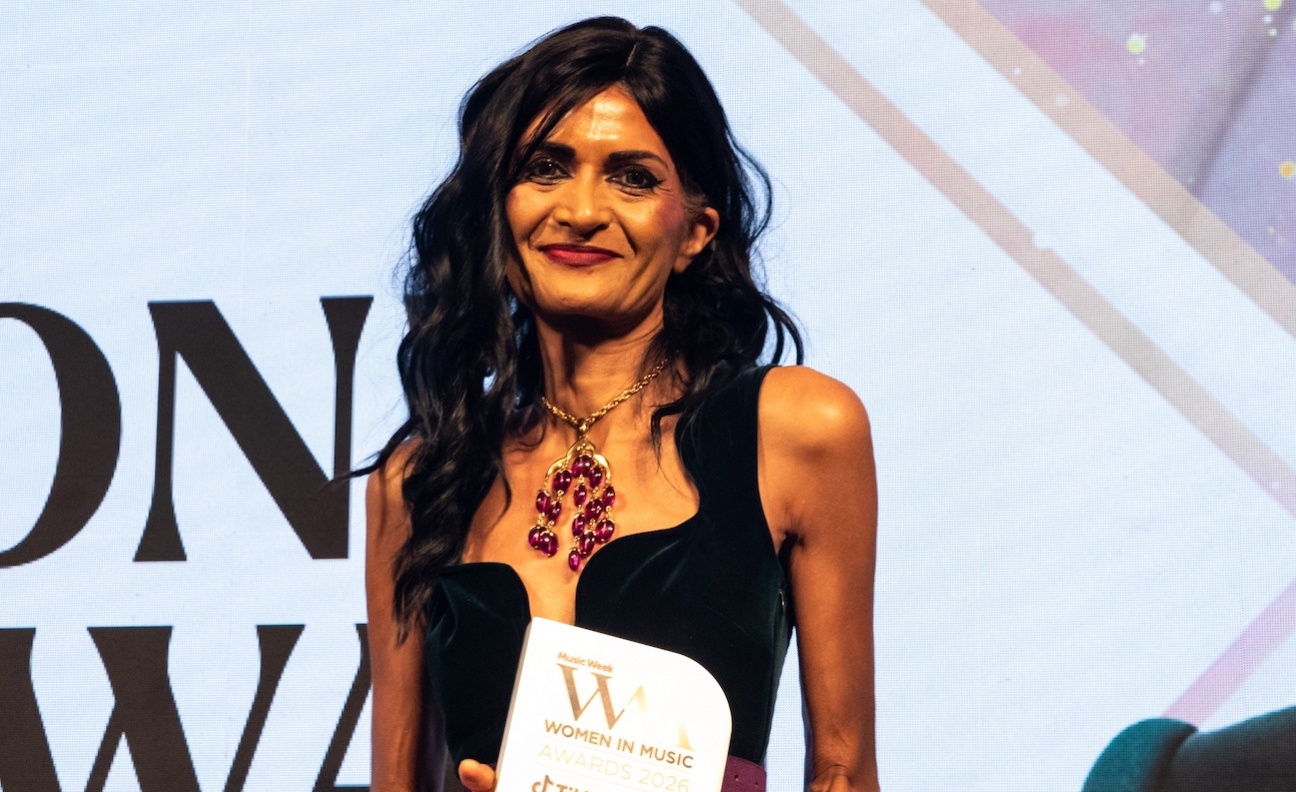
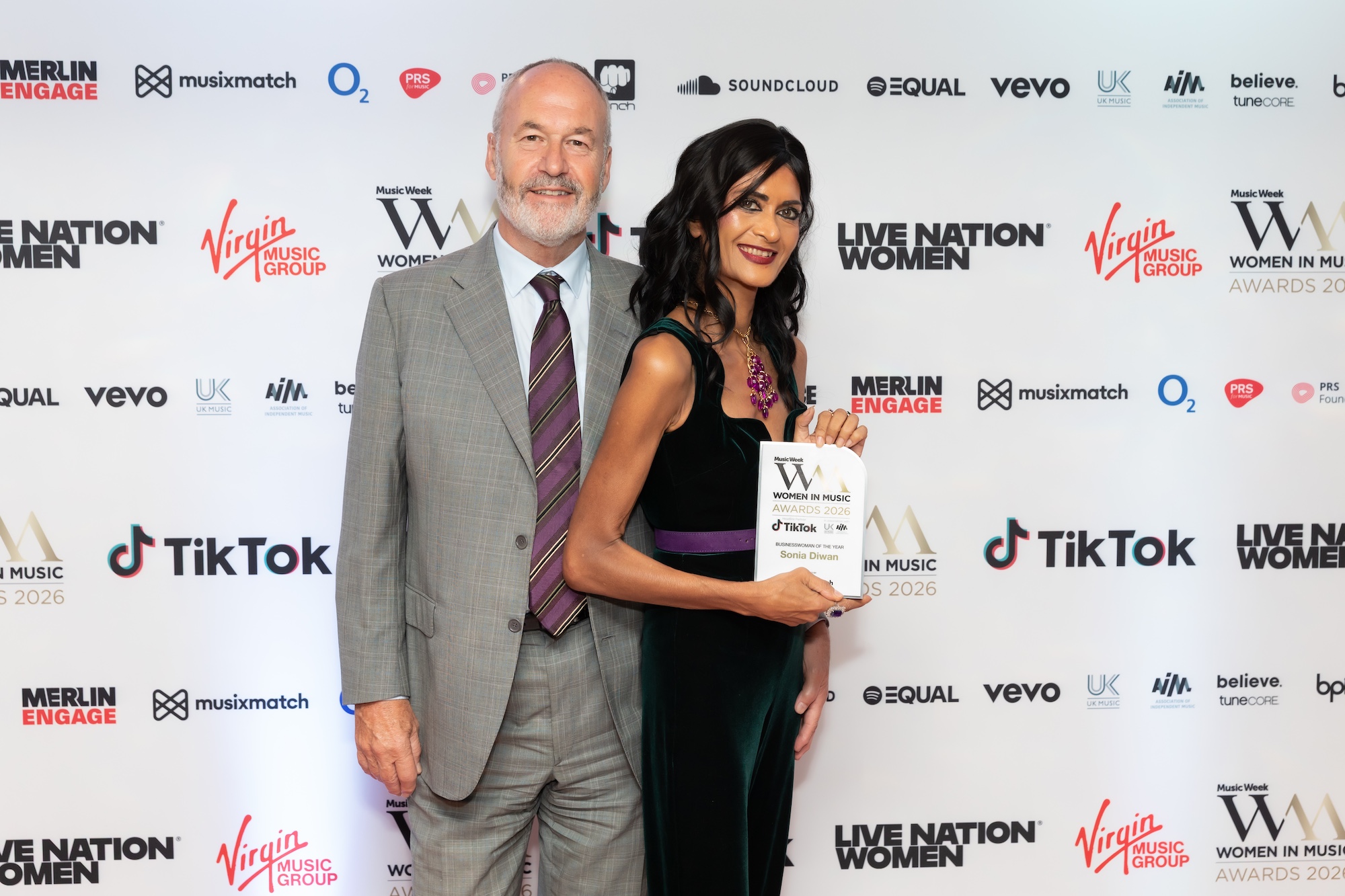
At this year's Women in Music Awards, we celebrated the achievements of game-changing executives and artists as the industry came together to honour their work. Music Week has spoken to all of the winners to tell their stories. Here, Sonia Diwan, winner of our Businesswoman Of The Year award, talks life in the fast lane of music industry law...
“Extraordinary, amazing!” That was Sonia Diwan’s reaction when she learned she had been named Music Week Women In Music Awards Businesswoman Of The Year, an honour that recognises not only the longevity of her career but the care, instinct and determination she has brought to it.
For three decades, Diwan, a specialist music lawyer, has been a trusted presence in the music industry. As a co-owner of Sound Advice, she guides artists, writers, producers, managers and entrepreneurs through the pivotal decisions that shape entire careers.
Her clients include some of music’s brightest names from Jonas Blue, Chase & Status, Naughty Boy and Paloma Faith, cutting her teeth on Grammy Award-winning production team Stargate, global superstar DJ Paul Oakenfold and the Wall Of Sound label, and having worked with global artists such as WizKid. Yet, for Diwan, the work has always been about far more than the headline names or the deals themselves. “Whether it’s with the artist, the producer, the manager, the songwriter, it just feels like you’re part and parcel of the process and a part of their lives,” she says. This personal approach extends well beyond traditional legal advice, encompassing everything from brokering catalogue deals and joint ventures to building bespoke label, publishing and brand partnerships. It is what has cemented her status as both a trusted strategist and a top-tier lawyer – bringing clarity, commercial imagination and the confidence to secure what her clients deserve.
After starting her career in film and TV law at Marriott Harrison and moving to Herbert Smith to handle BSkyB matters, Diwan honed her craft as a music lawyer at Lee & Thompson, where she rose to partner. She then left with colleague Robert Horsfall to launch Sound Advice, it was an opportunity to build something on their own terms: a talent-focused, entrepreneurial business closer to the daily realities of a music career.
Nearly two decades on, Sound Advice has become a trusted independent force, working across all things talent, whether recording and publishing agreements, catalogue deals, joint ventures, bespoke commercial partnerships or other. “The fact that we’re still standing 18 years on is a testament to our running a business that works,” she says.
Despite her success, her route has not always been easy. As an Asian woman entering music law in the mid-1990s, Diwan was often the only woman – and the only woman of colour – in the room. “When I first started back in ’96, ’97, there weren’t that many of me, certainly not that many females, and certainly not that many females of colour.”
Rather than allowing those early challenges to define the limits of her career, Diwan forged her own path and now uses her experience to help others find theirs. Through Cat’s Mother, an industry mentoring initiative, she supports young women looking to build careers in music. “This is a way I’m hopefully giving back in a practical sense to girls who wouldn’t necessarily think that they have a route into the music industry,” she says. “It means a lot just seeing their enthusiasm, how hard they’re prepared to work, and mostly just knowing that [the scheme] works in terms of them getting actual opportunities within the industry. That’s empowering for them and gratifying for us as mentors.”
On the eve of this year’s ceremony, Diwan spoke to Music Week about being honoured, building Sound Advice, the client relationships that have sustained her career and why experience remains vital in an industry being reshaped by AI.
Congratulations, Sonia! How does it feel to be honoured with this award?
“It's really tough for me to sit here and actually talk about this [chuckles]. I really wasn’t expecting it at all. I feel incredibly honoured and very humbled by the fact that Music Week and my peers have thought that I’m worthy of this particular honour. I feel very blessed. I didn’t go into this to get awards. The real sense of recognition and satisfaction I get is from my clients and the fact that they are incredibly loyal to me – it makes me feel like I’m doing my job properly. For my peers to also recognise that, of course, that’s wonderful. When I got the call, it was late Friday afternoon on a beautiful, sunny day. I’d just come to the end of a very long week, still reeling from the loss of a very dear friend of mine, [Bella Figura co-founder and CEO] Alexi Cory-Smith. That was weighing on my mind quite heavily, so getting the call was all a bit surreal.”
You were inducted onto the Roll Of Honour at the first Women In Music Awards in 2014. Does that give you a special relationship with the event?
“I’d like to think Music Week, George and the rest of the team feel that I’ve always been a strong supporter of the event. It’s something very dear to my heart. For Music Week to start the awards back in 2014 was so important – I think it’s vital that women across the industry are recognised in a way that maybe they haven’t been. I remember Ann Harrison, someone I looked up to and continue to respect, receiving her award. I remember being in the audience thinking, ‘I want to be her.’ It’s so important to have people inspiring the next generation. Maybe I’d like to think these awards can be inspirational. I know it certainly inspired me.”
Why do you think you have received this honour?
“It is hard to explain. But I do know that I am proud of Sound Advice turning 18 years old this year. We have created a small boutique music talent practice that has grown over nearly two decades, one which, I feel, punches above its weight. Running any business involves, at times, an overwhelming sense of anxiety, but couple that with every single one of our clients being their own business. They are at the centre of what they do, and they rely on me and the rest of our team to make sure that everything runs in the best way that it possibly can. I look at it as not only running Sound Advice as a business, but helping run our clients’ businesses too. I would like to think their loyalty reflects what we give to them, and that the industry sees us as trusted, experience and connected advisers. I’m also very lucky that I have great colleagues in Robert, Judge Jules and Alex Meiklejohn – I’m assuming that’s possibly one of the reasons why Music Week has awarded me this accolade.”
I've always looked at my job as being one-third music lawyer, one-third business manager, and one-third therapist
Sonia Diwan, Sound Advice
Do you feel enough is known across the industry about the realities of being a lawyer within the music business, and what do you want people to know about that?
“Interestingly, I think being a music lawyer is quite different to being a lawyer in other practice areas. I know it’s definitely changed over the last 30 years. We've become a more integral part of the team as contracts and the industry have evolved, meaning managers, artists, producers and writers look to lawyers to help guide them through the entire process. I've always looked at my job as being one-third music lawyer, one-third business manager, and one-third therapist, because helping creatives takes just as much listening as legal know-how.”
What has been the key to your success as a music lawyer? What do you need to be for your clients?
“Listen. Work hard. Have an understanding of the situation, and know when to push (and when not to). It comes down to being able to prioritise what’s important for your client, because every client is at a different stage of his or her career. Knowing what’s important to them at that particular moment is, I think, what makes a good music lawyer. Also, having a commercial understanding of the industry as it currently stands is equally vital. Looking after clients across all stages of their career gives you a really good grasp of what the commercial realities are. That’s what clients look to me for. I think that’s what managers look to me for. It’s all about working hand-in-hand with the team. It is for my clients to say why they’re still with me, decades on. Perhaps it’s a combination of working hard, always being available, and trying to do the best I possibly can for them.”
Looking back, what made you decide to co-found Sound Advice in 2008?
“Before we started up in 2008, I was a partner at Lee & Thompson. When you’re a partner in a law firm, you think you know how to run a business. When Robert and I decided to leave, it was all on good terms – we just wanted to create something new that was focused on music and talent. At the time, it was more than just a law firm; it was also an accountancy practice and a talent management company. We set up at the height of the double-dip recession in 2008. We decided to create this multidisciplinary outfit, which was super exciting. I was at that point in my career where I thought, ‘If I don’t do it now, when am I going to do it?’ The opportunity to create something new, have complete autonomy, and be the master of your own destiny was really appealing.”
How do you reflect on your path to this point?
“As an Asian female of my generation, there were only a couple of career paths I could go down - the options were medicine, law, accountancy, or dentistry. I did my first degree in medicine before realising it wasn’t for me. So the next one I tried was law. After graduating from Cambridge, I started at a film and TV law firm, then a brief stint in the City working for Herbert Smith. But I soon realised that this wasn’t for me either. I was lucky enough to get an interview at Lee & Thompson for a position in the music department, and they took a chance on me. I hadn’t done music before, and I think I was lucky because it was back at a time when they could take a chance on someone.
“It felt like I’d found my true calling. Getting up at five in the morning stopped feeling like hard work because I loved what I was doing. Having a champion in Robert made all the difference, and so putting in the hours wasn’t an issue because I loved it. You’d work a 12-hour day and then go out in the evening to see bands, to network. You make your own luck. I worked hard at .Yes, I enjoy the social element of our business, but I also enjoy what I do.”
In hindsight, what obstacles did you face on your journey?
“When I first started, there weren’t many people who looked like me, which was both interesting and a little bit intimidating. I’d walk into a meeting and I’d be the only girl in the room, let alone the only girl of colour. I’m from Wales, so I grew up on rugby. I’d walk into a meeting, and all the boys would be talking about football. I was thinking, ‘Okay, I could talk about rugby, but I can’t talk about football.’ I did go away thinking, ‘I’m going to have to choose a football team. I’m going to have to learn the offside rule.’
“I know that sounds a little bit tongue in cheek, but it was true. I genuinely felt that I had to find a way of getting past that particular barrier. My upbringing taught me that if you work hard enough, or you work harder than anybody else in the room, any obstacle that you may encounter, you’d be able to surmount, so this was different.
“It would have been great to have more role models back then. When I first started, there was the head of legal & business affairs at Virgin Records, a lovely woman called Shelagh Macleod, who sadly passed away. I remember being in meetings with her, thinking, ‘Wow, she is incredible. I want to be her when I get further in my career.’ But, not having a plethora of role models early on also allowed me to make my own pathway. There was nothing stopping me. I didn’t feel like there was a glass ceiling. I could just forge my own path.
As I have progressed, having the support and encouragement of so many of my female contemporaries was enormously helpful. Seeing them go on to break their own glass ceilings continues to be inspirational to me.
Finally, what is your biggest concern about the industry in 2026?
“AI. According to Jacob Coxon from Anthropic, humans could be obsolete in 10 years’ time. I really hope we don’t reach that point. I mean, no AI bot is ever going to come up with Joni Mitchell’s Blue, Stevie Wonder’s Songs In The Key Of Life, or George Michael’s Listen Without Prejudice. I genuinely believe that’s not going to happen. I still think that one's lived experience makes a huge difference, and that personal touch, you just can't replicate with AI. There are many things that are good about AI, but we have to be pragmatic about how it’s used. But things are constantly evolving, so my opinion may change in five years' time. All I know right now is that human experience remains irreplaceable.”
PHOTOS: Louise Haywood-Schiefer/Panni Renner