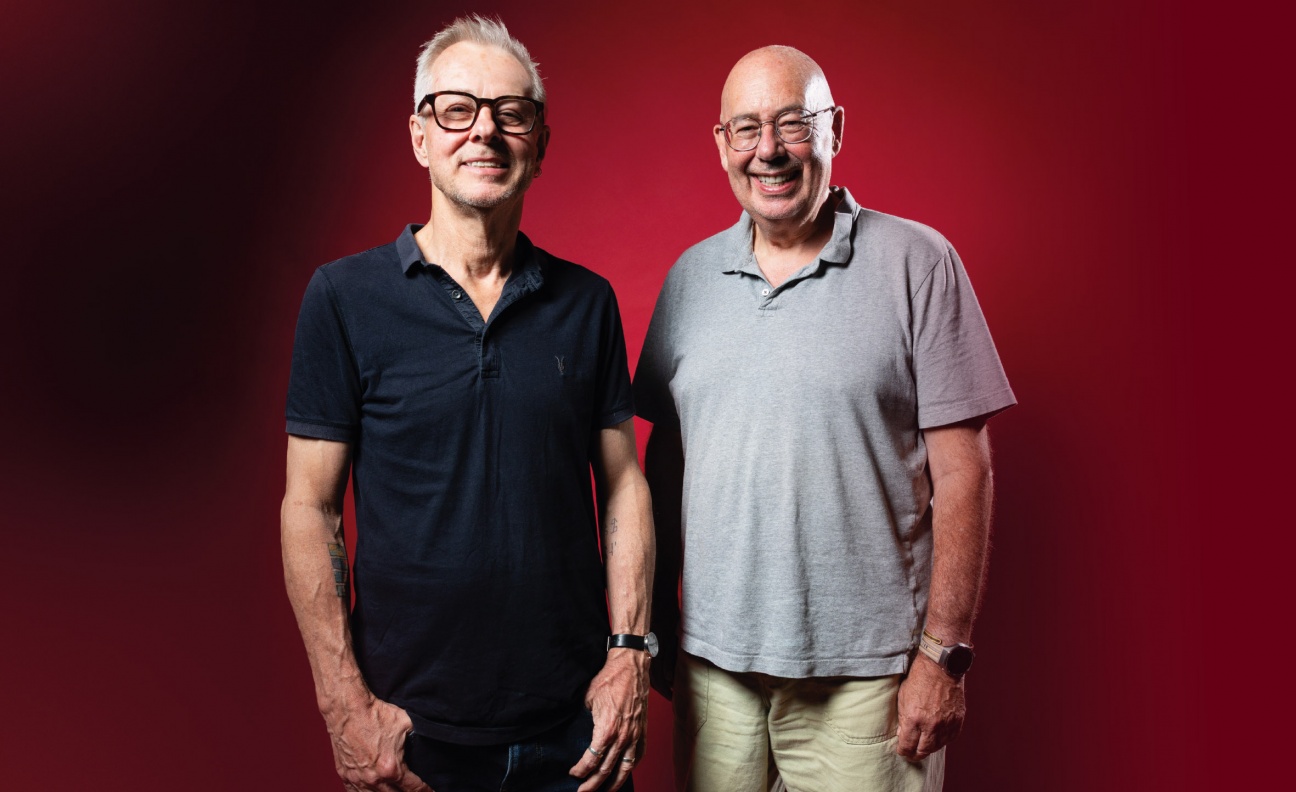
Cooking Vinyl co-founder & chairman Martin Goldschmidt and MD Rob Collins have looked back on four decades of the indie powerhouse as it celebrates its 40th anniversary.
In an exclusive interview in the latest issue of Music Week, the duo chat acquisitions, the highs and lows of running a label, and keeping the indie spirit alive.
The company’s moved into services with a 1993 deal with Billy Bragg, while its 2009 release of The Prodigy’s Invaders Must Die (760,200 sales, OCC) was a major commercial success.
Its business spans records, services and distribution, with recent chart hits including releases by Blue, James Morrison, Shed Seven, Deacon Blue, Embrace, The Darkness, Del Amitri, Passenger and Babymetal. The company was acquired by US music company Exceleration Music last year.
As part of the anniversary feature, artists and industry figures also paid tribute to the label.
The Prodigy's Liam Howlett said: “Congratulations to Cooking Vinyl on their 40th anniversary! Their independent attitude, teamwork and support for The Prodigy helped to deliver some great results and we wish them much success in the future.”
Cooking Vinyl is an independent label for independently minded artists, the first to fully embrace what an artist services deal could mean
Billy Bragg
Bragg added: “Cooking Vinyl is an independent label for independently minded artists, the first to fully embrace what an artist services deal could mean. They saw the benefit of offering deals based on partnership rather than purely the exploitation of rights. During the past four decades, my catalogue has reverted to my ownership several times, yet I’ve re-signed with Cooking Vinyl because their business model aligns with my values in ways that other labels simply won’t accommodate. It’s a partnership I value greatly.”
Meanwhile, AIM CEO Gee Davy also worked at Cooking Vinyl earlier in her career as its legal & business affairs manager.
“I joined during my mature law studies and ended up staying seven years," she said. "I wouldn’t be leading AIM without it. It was a baptism of fire; I arrived just as The Prodigy’s Invaders Must Die took off. There was Underworld, Villagers, Passenger, The Orb, Get Cape. Wear Cape. Fly and Billy Bragg. Shamus Damani taught me to fly and the rest is history. Fearless, experimental, one of a kind... And always Cooking.”
In the following excerpt from the interview, Goldschmidt and Collins reflect on landmark campaigns, Cooking Vinyl's sale to Exceleration and the changing landscape for independent businesses.
We’ve got behind virtually every release we’ve put out, always, and that’s always been our attitude
Martin Goldschmidt, Cooking Vinyl
Can you put your finger on what it is that makes Cooking Vinyl unique?
Martin Goldschmidt: “Everyone in the company is really motivated and loves working with bands and gives it their all to get the band further down the road. As Rob said, if the band leans into that, then we can make a massive difference to their careers. We’ve done it with many, many bands, making a massive difference to their careers. One of the other things about us is we’ve never really had a priority system, we’ve just tried to work really hard on every release we do.”
Rob Collins: “We’ve had to, to pay the bloody bills! It’s also quite old-fashioned in that the people who work for us love music.”
MG: “It’s different when a label signs 25 acts, throws them against the wall and whatever sticks, they get behind. We’ve got behind virtually every release we’ve put out, always, and that’s always been our attitude. We sign stuff because we want to work with the artist.”
Is it possible to pick out some of your favourite campaigns?
MG: “The Prodigy was amazing. It was a game-changer in so many ways. It just blew the doors off. With a band like that, you were able to do a lot of stuff that was groundbreaking in the industry.”
RC: “It opened the doors to [working with] Groove Armada, Marilyn Manson and Underworld – it was a great calling card. The other big pinch-me moment was having two No.1s with Shed Seven in 2024. We still work really closely with The Prodigy on the catalogue we’ve got; they’re really happy to work with us on represses and remixes and making things available that haven’t been for a while.”
Regarding the sale to Exceleration, how has it changed things?
MG: “It was crucial that our team and our artists would be looked after. It was great being able to tell the team that this would improve their job prospects and give them more job security. It was crucial to be able to say to the artists that this would really strengthen what we can do for them worldwide.”
RC: “The biggest impact – and this is always the case in acquisitions – is coming on the finance and royalties side of the business. Most of that is in the process of moving over to Exceleration, but in terms of the creative and the release schedule, they very much leave us alone. They want to know what’s going on, but we just run the show as we’d normally run it.”
MG: “And we’ve got so much more experience in Europe working with big artists at a different level. They value that.”
RC: “It helps them with Redeye, their distributor. It puts a lot of turnover into a fairly small distributor in the UK. They’re fairly big in the States and have a global operation, but having us on board really supercharges things.”
There’s still a massive independent route to market and it’s really healthy – there are lots of players out there
Rob Collins, Cooking Vinyl
Yours is not the only recent company sale in the indie sector. What have you made of the spate of major acquisitions of independent companies?
RC: “I think a lot of it is down to the individual. I don’t begrudge anyone doing a deal with anybody if they think it’s the right deal for their company.”
MG: “I think majors and indies, in general, make difficult bedfellows. Normally, there can be layoffs quite soon after a big deal. I think [PIAS] [which was fully acquired by Universal Music Group in 2024] is quite different because Universal are trying to compete with The Orchard. Sony’s biggest area where they can compete with Universal is through The Orchard, and getting [PIAS] – along with various other moves [Universal] is making – is part of how they’re trying to establish power in that area. But the beauty of what Exceleration does is that it provides an alternative to the majors. If you did want to find money or you wanted to exit, you used to have to go to the majors or a fund, whereas now, they do try to be partners and take a long-term view.”
How valuable do you think the independent route to market is in 2026?
MG: “We went through a phase of the independents thriving and now the majors have taken over that whole area of what used to be independent distribution. They really wanted that market share…”
RC: “And they’ve gone and taken it!”
MG: “I think it’s great that companies like Redeye provide an alternative to that. It’s really needed.”
RC: “Yes, I think there’s still a massive independent route to market and it’s really healthy. There are lots of players out there that offer a true independent route to market.”
Have you any sage advice for anyone starting a label?
MG: “It’s really hard, but it’s great fun – you’ve got to have a vision, be in a scene and work with stuff you understand, love and are really passionate about. You’ve got to be prepared to sacrifice a lot. It’s like being in a band – you’ve got to sacrifice so much and really believe in it. And there’s no guarantee of success. But the other side of it is, if you do get lucky and you do get it right… I’ve had a fantastic job for 40 years.”
RC: “You’ve got to surround yourself with good people and good advice. You do need a good distributor who understands digital more than physical if you’re just starting a new label off, but it’s the chicken and the egg – you’ve got to build up the turnover to get the distributors interested.”
Subscribers can read the full Cooking Vinyl interview in the new issue of Music Week and online here.