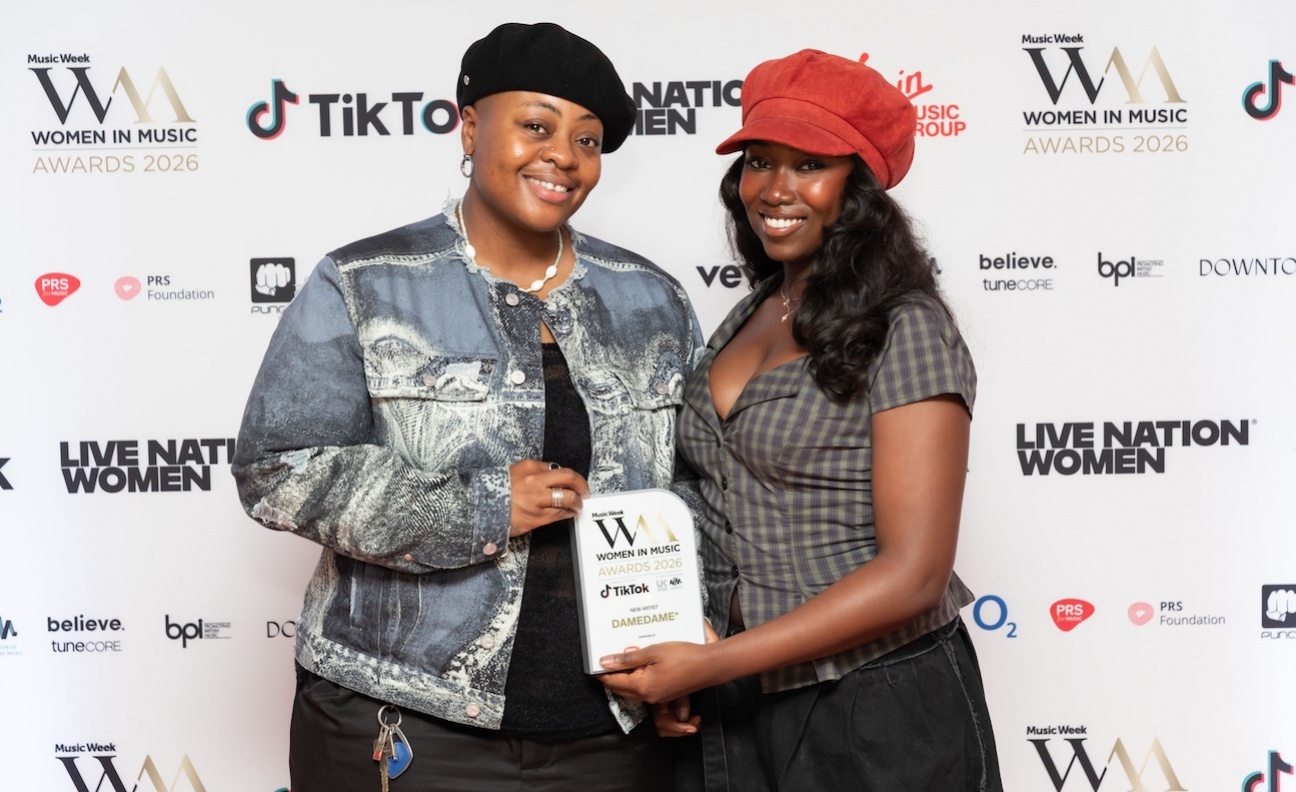
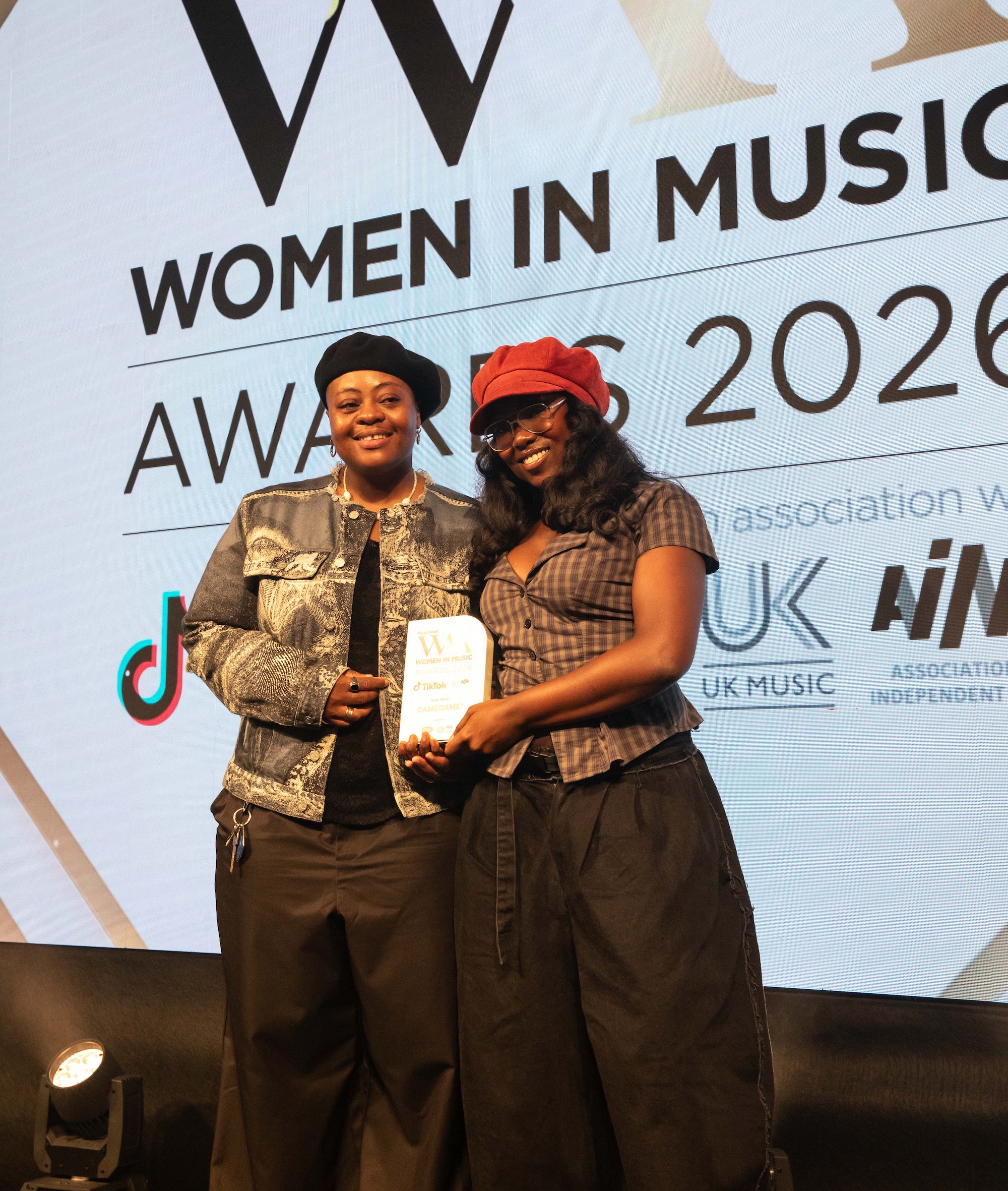
At this year's Women In Music Awards, we celebrated the achievements of game-changing executives and artists as the industry came together to honour their work. Music Week has spoken to the winners in all 14 categories to tell their stories. Here, DAMEDAME*, winners of our New Artist award, discusses their life lessons, representation for songwriters and their future plans…
Interview: Alex Rigotti
DAMEDAME* – Barbara Boko and Edith Nelson – were crowned the winners of the New Artist honour at the Women In Music Awards 2026. And it was richly deserved. Forming in 2018 in Walsall, the duo chose DAMEDAME* as a name – referring to the Ghanaian Adinkra concepts of intelligence and strategy, as well as nodding to Boko’s French heritage – and signed to Sony in 2022. They dropped their debut single, A Stranger, the year after, landing a coveted spot on the EA Sports FC 24 soundtrack. Since then, DAMEDAME* went on to write for some of the biggest names in music, producing the bulk of fellow Walsall native Jorja Smith’s 2023 album Falling Or Flying and racking up further collaborations with Tems and Wizkid.
This year, DAMEDAME* have finally released their debut album, Dreams On The Passenger Seat, four years after they’d signed their record deal. Here, they speak to Music Week about the journey to releasing their first full-length project, what messages the music industry needs to hear from rising artists, and why slow and steady always wins the race...
How do you feel about being crowned Best New Artist at the Women in Music Awards?
Edith Nelson: “I don't really know how to feel – it doesn't feel real, for some reason. We're still very shocked and surprised, to be honest. It feels like it was only the other day that we were struggling to get the music together and release it. So, to be on this side of things and be acknowledged for it is really crazy.”
DAMEDAME* have been around since 2018. What are some of the biggest lessons you've learned since starting out?
Barbara Boko: “Taking your time is definitely not a bad thing. During the process, I think we really started to feel like we were taking too long, but now coming out on the other side, I'm so glad we took the time we did and didn’t rush any of the music, even though it did cost us at the time. It was worth it.”
You’ve finally dropped your debut album this year. How does it feel to have your first project out?
EN: “It's a relief. When you think about all the hours in the studio, all the phone calls, and all the conversations where you’re doubting yourself, it's a relief to have all those lessons behind us. I think we finally feel like real artists; the outside world doesn't just see us as producers and writers for other people. It's great to have our own ideas, voices and stories out in the real world for people to actually get to know who we are. All our different personalities are out there as well, living lives of their own. We've been carrying this music for a long time, literally since 2018, so I feel so much more optimistic about the future.”
When you made your album, was there anything in particular that you felt was important to communicate that you couldn't through production work?
EN: “The scope of our inner worlds. When you're working on other artists' stuff, you're limited to what they're comfortable with, what their fans are willing to receive, what they're used to putting out, what genres they want to explore, all that kind of stuff. This allowed us to put together all our influences and express all the different parts of music that we love without any limitations.”
BB: “Being able to write about personal life shit and have our point of view out in the open has been really nice. You do it with other writing as well, but you usually compromise. This was a chance to home in on exactly what we wanted to talk about in our own songs.”
What are your thoughts on the support you got as young musicians in Walsall and Birmingham? Do you feel it was adequate?
EN: “It's a mixture, man. When it comes to the actual creativity part, yeah. I got lucky because I was always outside as a kid, and I knew a lot of people, but if I was a kid that didn't go out as much, I wouldn't have found anything.
“There are a lot of initiatives, workshops and community-focused clubs, and there's quite a big creative scene in Brum, but there's just no infrastructure to take it anywhere. A lot of talent gets lost that way in Brum. There are so many amazing artists and producers that we've had the pleasure of working with that you wonder, ‘Why haven't you guys been discovered, why hasn't it gone to the next level?’ And it’s just that there’s no infrastructure or industry to get them there.”
BB: “I think it's very supportive. You're feeding a little baby, essentially, and nurturing it without having any ulterior motives, which was really good for both of us because we got lucky. I think [the absence of an industry] is a blessing in disguise, because I can imagine in places like London, where there's so much at stake, the whole energy around making music will be a lot colder and more competitive.”
EN: “You're not gonna get supported for free, do you know what I mean?”
A lot of talent gets lost in Brum... There are so many amazing artists and producers but there’s no infrastructure or industry to get them to the next level
Edith Nelson
What did you make of the industry once you found your feet in London?
EN: “It was weird, I'm not gonna lie. I don't think we liked it very much, to be honest. We realised very quickly it's a small world – everyone talks to everyone, everyone knows who everyone is. You can't say something to one person and not expect the next person not to know. So, that was the first thing. Learning how to divide your personal self from your industry self was unusual for me. It's also quite fickle, figuring out what people's motives really are. It’s a bit of a mad circus. Eventually, we realised that we're safest in the studio, so we retreat there as much as possible.”
BB: “It was definitely a whole new world. There's so much going on – and we didn't know any of this. For any artist entering the industry, there's so much to learn. It's overwhelming: you have to have a lawyer before you sign anything, but then it's like, how do you know if that lawyer is the best person for you? It's very hard to make an informed decision.”
On the track SMS, you rap, 'I don't like listening to the opinions of the Western man/I don't like sitting in these meetings while they're rubbing their hands'. Do you have a message for the industry on how they can improve?
BB: “Pay writers. There's no other industry where the person who makes the product doesn't have a wage. It's just as important as the producers – and we're also producers – but if you're writing the song…”
EN: “…You should get a writer’s fee. It’s not that complicated [laughs]. I think they should let artists be artists as well. I was saying this to my manager the other day. We want the quality of music to remain high, and we talk about the past as if it's some mystical era where artists used to be so much more unique, but all those artists didn't spend their life on the internet. They didn't spend their days figuring out what content they're going to put out. All of that compromises our ability to go through all the real life motions that you need to go through, to be a great and potent artist. I just think there's a cognitive dissonance between the music they want people to put out and how they actually expect us to live.”
Another pressure facing young musicians these days is achieving a viral hit. Did you ever feel that?
BB: “No, not at all. Our label’s been incredible. They've been super supportive, and the one thing they do not mess with is our music. Our A&R has let us be as free as we want with the kind of music that we're making, and as experimental as we want. There's been no pressure on hitmaking because if there's anything that our team knows about us, it’s that we can't work under that kind of pressure. We have to be left alone and allowed to create whatever we want.”
EN: “Yeah, we often get told that we're spoiled and we're lucky, so we make the most of it.”
You’ve been friends for years. Has that bond helped you navigate the industry?
EN: “We always say we don't know what we would do if we were doing it alone.”
BB: “We have serious six-hour-long conversations and debates about how we're gonna handle every single move. So it's nice to have someone to bounce ideas off and strategically plan how we want our career to go.”
You’ve produced for some big names, including work on Jorja Smith’s 2023 album Falling Or Flying. How did that come about?
EN: “Jorja happened to be in a collective and friendship group that I was also a part of. We'd never linked up to make music until 2020. We'd set up our first studio in Birmingham city centre, and one of my good friends brought her around. I think it was that grey area between Christmas and New Year's, and we just hung out and watched a movie. Then she came back, and we had a jam session with her and some other friends, and it just rolled on naturally. Eventually, it was like, ‘We've got enough little ideas here – do you guys want to jump in and make my album?’”
How did your studio sessions with Jorja impact the music you made?
EN: “Her enthusiasm and belief in us was massive. Jorja could work with anyone in the world, and she chose to do it with us. It put a battery in our back, like: ‘Wow, that means what we make is actual music that can actually be toured, streamed and put on adverts.’ We felt like we were good enough to actually do this in the real world, and our little quirks didn't stop us from getting where we needed to get to – they were embraced. We felt like we weren't weirdos anymore. She made us feel really, really comfortable and loved.”
BB: “I think also, as we got deeper into the project, the part where it got really challenging was when we had to finish it under a time limit. We had never really finished a song professionally to the point where it would get mixed and mastered. So that was really eye-opening for us – understanding how it feels to finish a song and not necessarily be like, ‘This is the perfect song.’ We took very little of that when we were doing our own album, but it still helped us realise when a song's in the 85-to-100% range, you can let it go.”
Pay writers... There's no other industry where the person who makes the product doesn't have a wage
Barbara Boko
As Black female producers in a white, male-dominated field, what your experiences have been like and what advice do you have for other women of colour coming up in the space?
BB: “The main advice I'd go with is not to take in any of the stats. When we started production, it was just something that we came across naturally. When we got into the industry and everyone was like, ‘Oh my god, you’re female producers,’ it was just like, ‘We've just been doing what we've been doing this whole time.’ But navigating through it, it's been pretty calm. I think a lot of female artists were really grateful to be able to get into sessions with women and work with people who are just like them.”
EN: “I would say you should never stop learning. That's one thing that's helped me a lot: always looking for new methods and new software plug-ins. Now there's so much information – everything is literally in your face. You can watch Grammy-winning producers working online.”
BB: “It's not about having some SSL desk with vintage bloody compressors and stuff in some expensive studio. Now you can just get a laptop and download an app. As long as you have passion, time and dedication, you can be a producer. It's actually pretty easy.”
Now you’ve released the album, what’s your vision for the future?
EN: ‘We'd love to get our live show together. That's our number one goal right now. We haven't performed together ever, and we’re excited to see what that looks like. We've got two collaborations, so we'd love to get some features and be out in the world fully as artists with a little bit of production sprinkled in. What else were you thinking, Barbs?”
BB: “Keep on making sick music! I have been getting this horrible fear of, ‘What's next?’, because when you've finally put something out, you've got to do it all over again. That's scary, but I'd love to keep putting out great music, being more confident in front of the camera, and discovering ourselves visually as artists.”
PHOTOS: Louise Haywood-Schiefer/Panni Renner