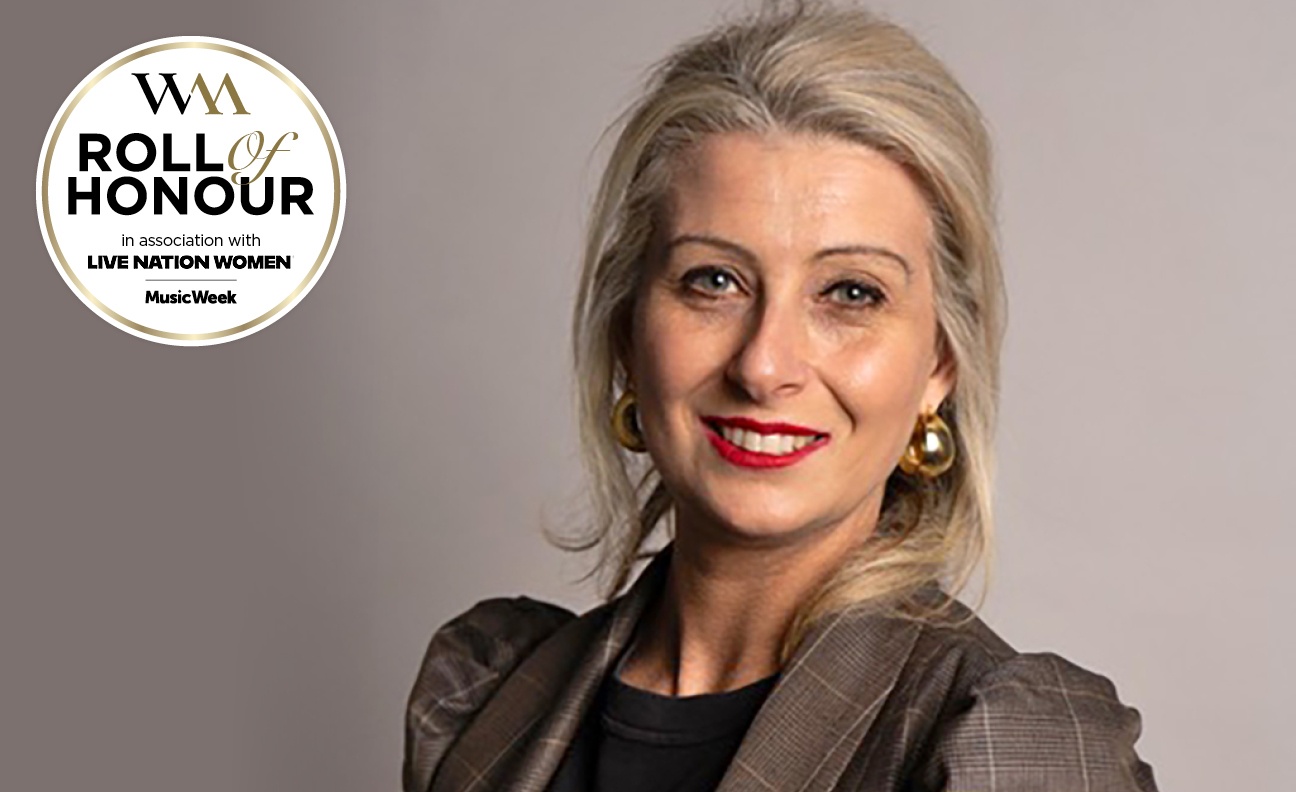
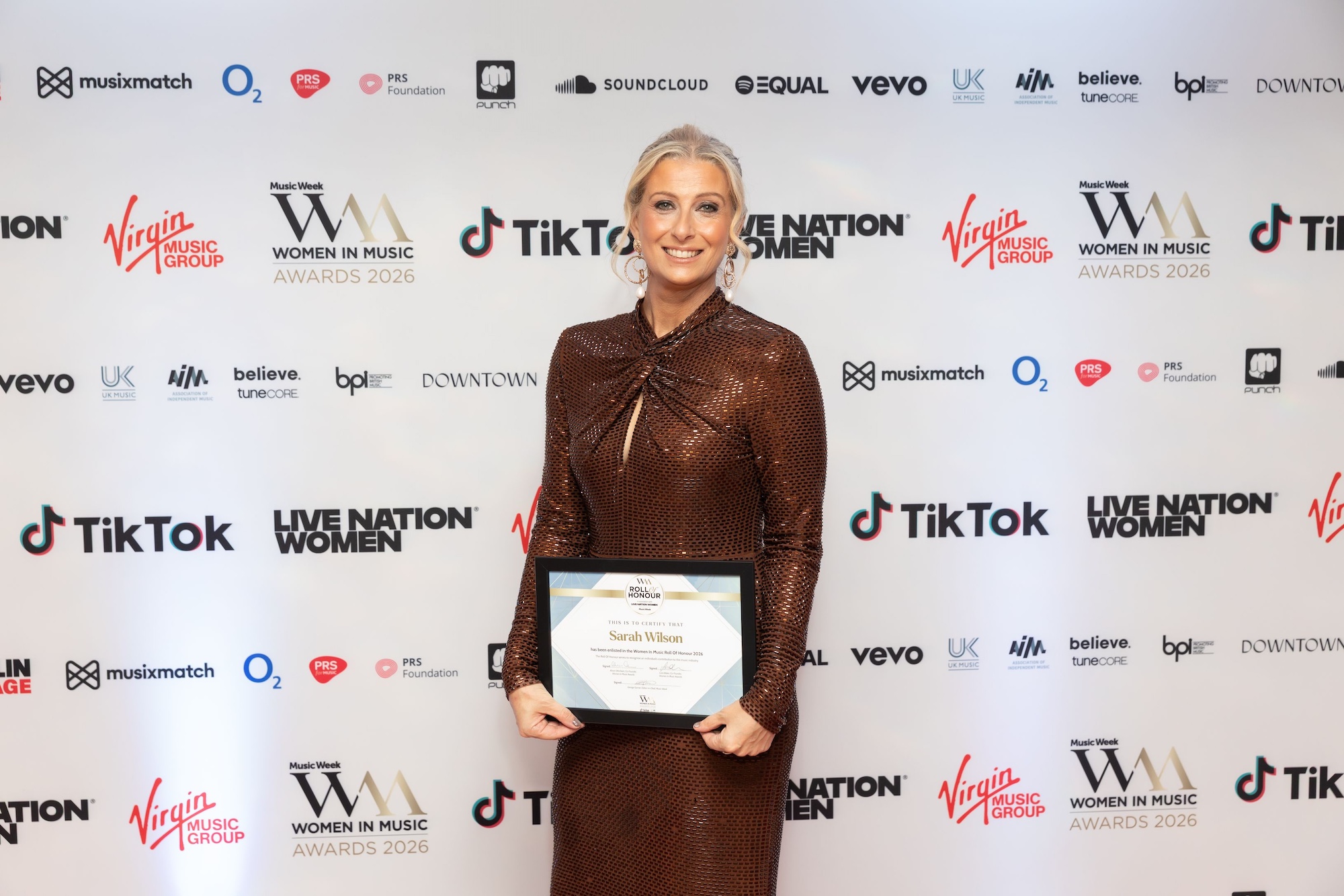
During the Music Week Women In Music Awards 2026, we inducted a host of trailblazing industry executives into the Roll Of Honour, in association with Live Nation Women.
They join a huge list of previous honourees, including some of the leading names from across the business like Kanya King, Emma Banks, Charisse Beaumont, Rebecca Allen, Stacey Tang, Laura Monks, Shani Gonzales and Mary Anne Hobbs, who have been selected since the awards began in 2014. The Roll Of Honour aims to shine a spotlight on the variety of individuals who are leading the charge in the music industry and consistently using their platforms to support women, or focus on empowerment and gender disparity.
Following the Women In Music Awards ceremony, Music Week is running Q&A interviews with all of this year’s Roll Of Honour inductees.
As head of UK, Ireland, Australia and New Zealand at TuneCore, Sarah Wilson is responsible for managing the local business, building the company’s artist roster in her regions, and supporting local artists via partnership opportunities and marketing initiatives. Since joining as head of TuneCore in 2021, Wilson has embedded the company into the UK’s music industry ecosystem, cementing it as an artist development partner for every level of artist and release.
Over the course of her 20-year career, Wilson has held senior positions at some of the UK’s biggest music companies across a range of sectors, including a 13-year stint as head of international at independent giant, Beggars Group. During her time at Beggars, Wilson was involved with some of the company’s most popular artists including Adele, Radiohead, The National, MIA and Bon Iver, as well as group labels XL, 4AD, Rough Trade, Matador and Young.
Following a period of working as director of global artist marketing at The Orchard, where she worked with BTS, Wilson became VP of international marketing at the world’s biggest music company, Universal Music Group, in 2020. There, she led a newly restructured team representing EMI, Polydor, 0207 Def Jam, Island, Capitol and Decca, working on global content strategies for ex-UK, and pushing the artist proposition to all territories. Here, she looks back on her journey so far...
How do you feel about joining the Roll Of Honour?
“To begin with a cliché – I’m absolutely honoured! The calibre of women represented this year, and in years past, is truly inspirational and it shows just how much we achieve, across every part of the industry. We need to keep bringing each other up and encouraging excellence at all levels.”
Looking back, how do you reflect on your early years getting into the industry?
“There was equal amounts of hustle, luck and a total lack of self-awareness. When I think about the sheer cheek of that younger person, I feel sad that we’re moulded by society and ‘rules’, especially as women, to play the game more. Coming from a family with absolutely no connection to the arts, in an area that didn’t recognise creativity, I fought the odds, but only through sheer bloody force of will. When I think about starting out it was a case of making your own opportunities, so starting a fanzine in my case, consuming and learning, and creating community when at gigs. Things really haven't changed that much! I was pretty tunnel-visioned in what I wanted to do, and connections through university helped – I studied journalism. As women we need to remember that original fire that spurs us on – society has a habit of dampening it! I’ve had so many pinch me moments. I was the biggest Interpol fan and I ended up working closely with them at Matador. I will never take moments like that for granted, and often go back to them if I’m being a diva about something unimportant.”
Did you have a mentor at that stage?
“I didn’t, but I wish I had, and it’s something I feel passionate about now and will always sign up for. For both the mentor and the mentee, that exchange of experience, approach, successes and fears is of such value to both parties in keeping the growth of our industry going. In an age of quick judgement, it also encourages tolerance and understanding between seniority levels, fostering deeper connection and ultimately better teams. The music industry can be a lonely place; it’s often unregulated, unqualified and at times open to abuse – having a safe guide can be invaluable.”
Having worked across the independent and major sectors across your career, what would you say are the cornerstones of your approach to working in the music business? What philosophies have you lived by that have helped you thrive in both areas?
“The lion’s share of my time has been at independents in labels and distribution, and that is truly where my heart lives. That ability to be nimble, test and learn, experiment – that is the thing that creates the blueprint for ‘new.’ I look at collectives like Forever Living Originals, and the uncompromising work they produce, often by the skin of their teeth and by breaking all the rules, that could only happen in a setting that gives flexibility to the last moment, both operationally and creatively. The other thing I always tell my teams, no matter where I am, is that what you’re working on is someone’s career. It may not align with your taste, but the art that that person has produced is now in your hands. The alchemy of making music is so powerful that the last thing I’d want is for that magic to dissipate when it reaches ‘the industry’, so always rep it like it was your own.”
On top of your day job, you became a Patron of the Independent Venue Community, helping venues to become local community hubs. Why are indie venues so close to your heart?
“This is where it all starts. Without the sticky floored local venue, we have nowhere for artists to take that first step on stage, for audience discovery, for festival headliners of the future to hone their craft and for, in the brashest terms, the next part of the music economy to develop. In a post-Covid environment, where running a small venue is devastatingly hard, they’re more vital than ever – particularly in the face of AI-slop. But those venues have to survive, and that can only happen by diversification of income, to solidify them in the heart of the community day and night.”
Likewise, last year, along with co-chair Trina Smith, you relaunched the UK chapter of Women In Music, the global nonprofit organisation promoting equality for women in the UK music industry. What progress have you made so far?
“We’ve spent this year working with the US-based global team to get our structure in place here making sure we have every position represented and will be launching key initiatives by the end of this year, so keep watch! It’s been crucial to make sure we’re offering across demographics, so looking to segment needs has been top of mind.”
What’s your biggest achievement so far?
“My own build. Instagram life makes it look like we’re all just a collection of our greatest hits, but our B-sides and outtakes are messy as hell. Learning to balance your own professional ambitions, motherhood and disappointments takes some deep self-talk. I’m no longer scared to show vulnerability and cracks – if anything, these are learning moments. In an age where we communicate more than ever, make sure it’s authentic. Being real takes self-confidence and bravery. Now, if someone will teach me time management, I’ll be the full package. Additionally, being a senior member of a key business in one of the fastest-growing parts of the industry is not something I take for granted. TuneCore and I have grown together for the last five years and, as more artists choose the independent path, it encourages my personal journey every day. I’m a collection of my experiences, good and bad, and always try to take the learnings from each chapter.”
As women we need to remember that original fire that spurs us on – society has a habit of dampening it!
Sarah Wilson, TuneCore
Can you share some advice to young women about enjoying a successful career in music?
“Take the phone call, meeting, gig invite, coffee etc. This is, and will remain, an industry that’s based on people, and so many of my ‘moments’ have happened due to the luck of meeting the right person. That’s not going to happen solely by being on a laptop. Especially in this age where there’s absolute digital overwhelm, an in-person connection can resonate much further than yet another email. Secondly: understand the business. You will only get so far until you hit a P&L, references to EBITDA [Earnings Before Interest, Taxes, Depreciation, and Amortisation] or even a simple budget – all the unsexy parts. These are often untaught, so get ahead of the game.”
What’s the best advice you’ve ever had?
“Look around you! It’s natural to focus solely on what you’re doing, but you need a holistic take on everything, both for your own personal development, the good of your career and those you work with, and economically.”
Is there a young woman you'd like to shout out who you think is a rising star in the industry?
“Absolutely – my amazing marketing manager at TuneCore, Amanda Abramczuk. She approaches everything with creativity and humour and throws a banging party! It’s wonderful to work alongside someone ambitious and hungry, and both learn from one another.”
Similarly, is there a young woman artist whose music you're enjoying right now/excited about?
“Mellina Tey, who joined TuneCore last year. We’re all obsessed. She’s a London based R&B artist who’s cinematic, mysterious and talented as hell. Her incremental growth is entirely on her own terms. She’s fiercely independent, has been granted the Step Up fund, and has a singular vision on how she wants to progress.”
Finally, what’s your biggest lesson from 2026 so far?
“In the same way that 2026 seems pivotal from a climate standpoint, it’s also the year where we’re clearly slap bang in the next big revolution for music. AI is here to stay, so educate yourself and know what your opinions are. Everyone will have a different acceptance level, but like all things, approach with nuance.”