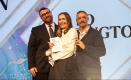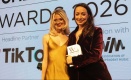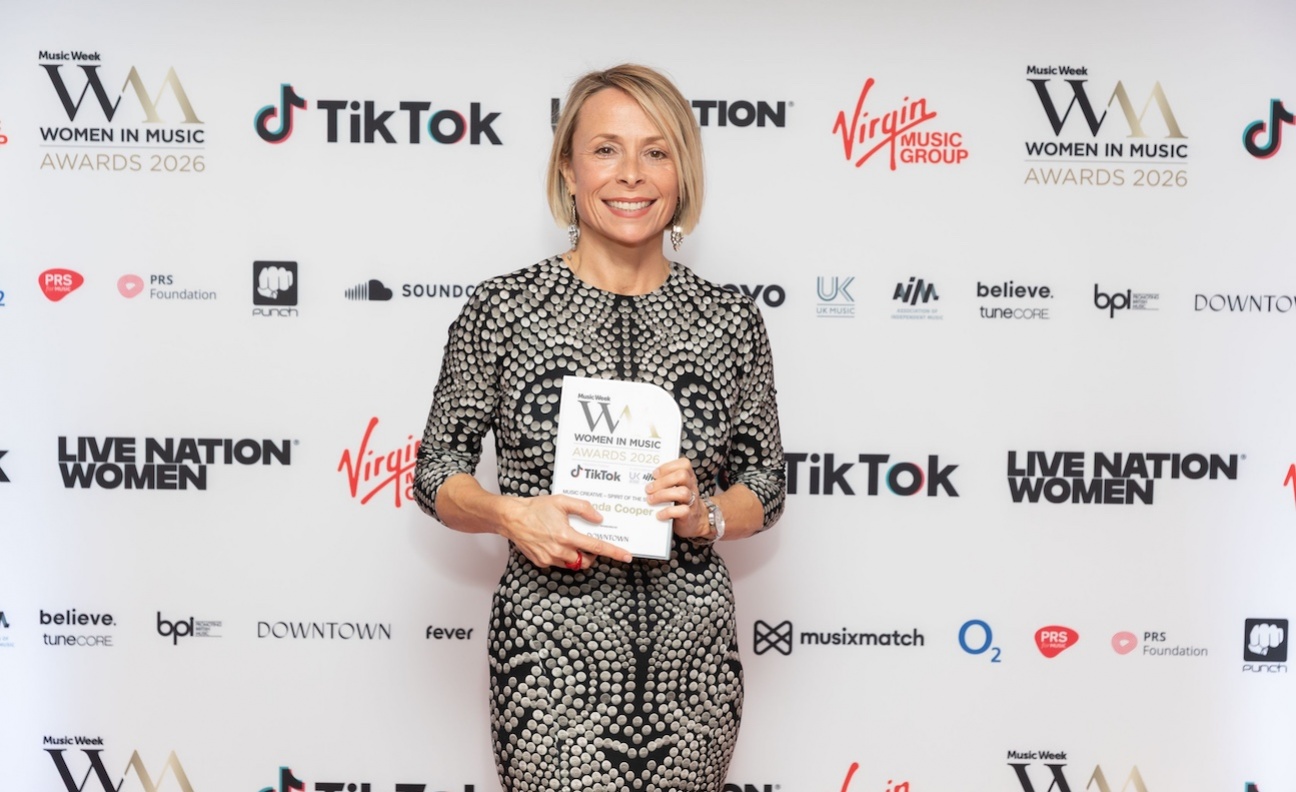
At this year's Women In Music Awards, we celebrated the achievements of game-changing executives and artists as the industry came together to honour their work. Music Week has spoken to the winners in all 14 categories to tell their stories. Here, Miranda Cooper, winner of our Music Creative – Spirit Of The Studio award, discusses her hitmaking journey…
Miranda Cooper hasn’t had a conventional songwriting career, at least not in her view. She moved from being a dancer to an almost-pop star to the era-defining Xenomania hit factory, working on some of the biggest hits of the 2000s with artists such as Girls Aloud, Sugababes, Kylie Minogue and Pet Shop Boys.
From there, her career has gone from strength to strength, becoming a trusted collaborator for artists such as Jessie Ware and Maisie Peters, and building an extraordinary parallel body of work in musical theatre. She is also a campaigner: since 2024, she has been president of The F-List For Music, the UK’s leading not-for-profit directory and advocacy organisation for female and gender-diverse musicians and songwriters.
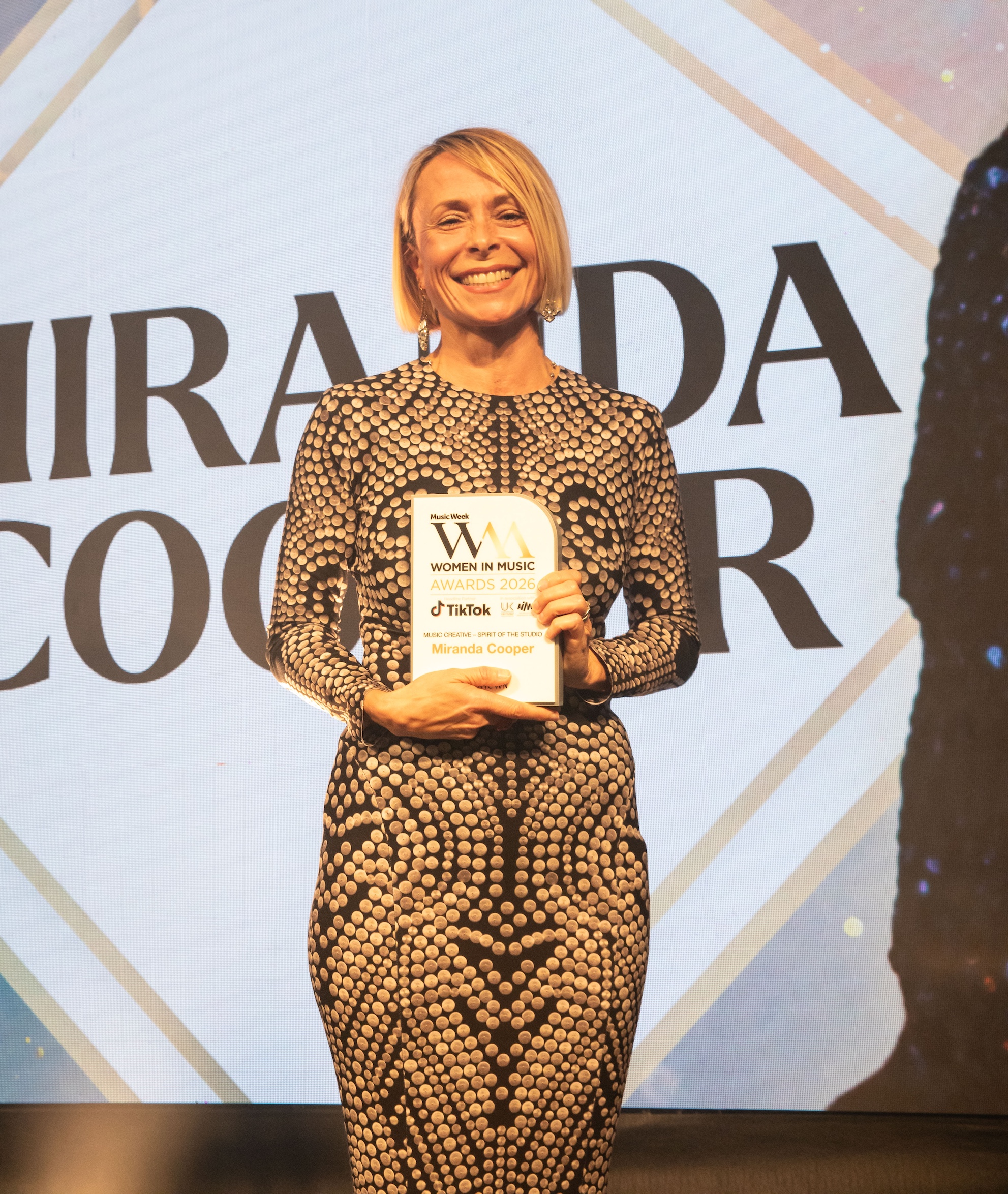
All of these are compelling reasons for Miranda Cooper to win this year’s Spirit Of The Studio award.
“It’s really exciting to win,” she says. “It’s come at a time when I’m looking back and realising that my songwriting experience has been pretty unique. My journey felt at times accidental and there were probably parts of it that I was trying to bury in order to be taken seriously. Now, I realise my voice is my instrument and the way that I have written – a way that has obviously worked for me – it's not necessarily an intellectual process. It's an instinctive process.”
Her unique experience has also produced a unique body of work. A Miranda Cooper song will never take the obvious path and is always the better for it.
“I am a big fan of the wonk,” she says. “I like things to have something unexpected, something that shouldn’t make sense.”
This wonk has worked. Cooper collaborated on almost all of Girls Aloud’s original singles, from their Christmas No.1 debut Sound Of The Underground to The Promise, which won the group their first BRIT Award in 2009 ahead of their hiatus later that year.
And she’s still having hits. Cooper was the co-writer on Jessie Ware’s I Could Get Used To This, from this year’s album Superbloom. It's unsurprising that so many top names in the music business are in awe of her.
“Miranda’s contribution to pop music is extraordinary,” praises Shani Gonzales, president at Warner Chappell Music UK. “From writing defining, record-breaking hits to shaping the careers of iconic artists, her creativity and sharp instincts remain second to none. She represents the absolute gold standard of songwriting. Everyone at Warner Chappell is delighted to see her recognised with this award.”
To celebrate her win, Music Week sat down with Miranda to talk about her career, her thoughts on the industry and her love of the wonk.
How do you feel about winning this award?
“It feels wonderful. I haven’t had an award just by myself, or been recognised by the industry in this way, so it’s really exciting and a chance to look back. The opportunities I have had have been amazing. I trained as a ballet dancer, which is all about conforming. So when Xenomania’s Brian Higgins gave me the opportunity to have my own voice in the studio, that was incredible. It all feels part of an exciting, mad, unique journey.”
You’ve championed women in the industry in general and through your work with The F-List. What does being part of Women In Music mean to you?
“When I started out, a lot of the female artists and writers around me were conditioned to think there was only a certain amount of space at the table for us. I felt so lucky and grateful to be one of them; I didn't ever want to rock the boat. We were lucky at Xenomania – in our bubble there, I never felt less-than. I came of age with ladette culture, which was loud and shouty, where we felt we could be as good as any man. I believed it was a level playing field and I believed nothing would change when I had kids… When I became a mum, I was suddenly like, ‘Oh fuck’. What happened?’ I was going to do it differently. There are so many female creatives who just go missing in midlife, and I am starting to allow myself to get really angry about that. So I really value this award, in a way that I perhaps may not have done 15 years ago.”
Tell us a bit more about your work at The F-List.
“When I first saw The F-List, before I became president, there was the font and an attention-grabbing, angry name, and it really resonated with me. I feel that, in some ways, I am making up for lost time and I regret maybe not lending my voice to the things that I believe in earlier. I feel like I'm able to do it – I'm able to shed whatever stuff that was from the past. I'm excited to speak up.”
Looking back to the beginning, where did your journey into music start?
“I grew up in Hampshire, in the country and we were quite privileged. We were outdoors all the time. There was a lot of imagination going on. We watched a lot of musicals like Grease, Bugsy Malone, Cats, Starlight Express. But there was also the music coming from my older siblings in the attic, like The Clash, Blondie and The Smiths. I was desperate to go to performing arts school, and I did when I was just nine. I found my tribe there, although it was very strict: we had to curtsey to every member of staff in the corridors…
“When I finished school, I was taking a class at [London’s legendary] Pineapple Dance Studios. Dannii Minogue had been watching from the street, and as I was leaving I had a tap on the shoulder and it was her manager saying, ‘Dannii wants you to come upstairs and audition for her video.’ I became a commercial dancer and danced for East 17, Peter Andre. I toured with PJ and Duncan for two years and did the Eurovision with Gina G. That was where Brian spotted me. He and Pete Wiggs and Bob Stanley from Saint Etienne were looking to put together a Europop group.”
Going on to work with Girls Aloud must have been quite something…
“It was amazing. It's hard to say where we started and they ended. We needed them. They needed us. We went to the Pop Stars: The Rivals house where the 10 final contestants were waiting to be played their uplifting, gorgeous ballad. And we gave them Sound Of The Underground. They were a bit, ‘What the hell is this?’ but they trusted us. Throughout those years, we were basically the same: young women in the early 2000s, now making a bit more money than our other halves, looking at our careers and how we would navigate them. They gave me wings. They were crucial to the process. They would sing every melody – and there were tons of melodies – five semitones up and five semitones down. It was so we could find what worked perfectly and it sometimes made the difference between a hit and not a hit. I love all of their songs; it’s hard to pick a favourite.”
What's the biggest way the game's changed since you started?
“Social media, having all that noise – it's all so fast, the idea of incubating isn’t there so much anymore. I met Brian [Higgins, of Xenomania] in 1997. I did my Moonbaby project with him, where I was the artist, and that didn’t work. But all the time, we still were moving forward and it felt really exciting. By 2002, I’d had my first hit as a songwriter. I had time to immerse myself, away from everything, away from even the artist. I know the Xenomania experience was not the industry norm, though. I had a big shock when I left because I was used to spending weeks, even months or years, on ideas and having an incredibly close-knit team.”
I am a big fan of the wonk. I like things to have something unexpected, something that shouldn’t make sense
Miranda Cooper
What’s it like in the studio these days, working with people like Maisie Peters and Jessie Ware?
“Different strengths are required, and ultimately, it's about supporting the artist. I met Maisie when she was 18, and we wrote for quite a long time before anything was released – John Hughes Movie was the first that song came out. Working with artists who also write is incredible; with Jesse, I loved being able to write about things that mattered to both of us. There was probably a point not that long ago where I was thinking, ‘Oh my God, I'm not in the club, I'm not 25, my voice doesn't have any value.’ But I'm realising more and more that it does.”
What defines your work as a writer?
“Probably how much I care, how much I put into it. And I am always looking, sometimes to my detriment, for the wonk. I'm looking for originality. I remember there was a period of, like, really conversational lyrics and it was my downfall because I thought, ‘That's the exact opposite of my USP!’”
What happens when you sit down to write a song?
“I have my process where I have all my lyric ideas and my concepts and everything in front of me… but the way that I write, it just pours out of me. Then, obviously, at Xenomania we couldn’t just wait for that to happen, so it became like working a muscle. By the end of my time there, even if a washing machine was going round, I could come up with a melody for it. When I became a mum and was pumping, I would literally come up with melodies to the breast pump. Make of that what you will!”
What do you think is the biggest challenge facing songwriters at the moment?
“The fact that they are not making any money. I'm in an incredibly privileged position. I caught the arse end of CDs. When I started writing, there was a level of songwriter who would not even have the singles, but would have track 11 on an album and make a perfectly good living. And that's completely disappeared. There’s also so much noise and people comparing themselves with one another. I do, however, love the fact that people like Sabrina Carpenter and Olivia Rodrigo are working with just one or two collaborators. There was a crazy period where it felt like everyone had FOMO and everyone was going everywhere, 'Maybe if we go to LA we’ll get this!' But I think for artists it's really good to have that intimacy and trust. And from that comes experimentation, which is often where the magic is.”
What do you think of the current state of pop?
“It's great. I love Lola Young, I love Charli XCX. I love Olivia Rodrigo, Sabrina Carpenter, Chappell Roan – there's this wave of brilliant female artists. I'm excited by them. They're doing their own thing, they're sticking to their vision, and I'm finding it really inspiring. When pop became incredibly dance-heavy, I found it a little bit harder to see where I might fit in. But now I'm back on my territory. It’s got a bit weirder. There’s wonk wherever you look.”
What's your take on AI and the ramifications for songwriting?
“It’s pretty terrifying long-term – across everything, not just not just our industry, and what it means for us as human beings. I was very resistant to it, but probably in the past six months or so, I have been using it more as a tool. Fortunately, if you've ever tried to get it to make any lyrics, they're just not good. But I find it interesting as an inspirational tool. I've gone to various dinners at the House of Commons, and I think it's quite helpful for MPs having to make decisions on AI to come face-to-face with the faces of pop to humanise the whole discussion. The idea that anyone can take anyone's copyright and just use it is deeply offensive and upsetting. Although, of course, the problem is that it's already been done.”
What more do you think the industry could be doing for writers?
“Valuing them. There does need to be some sort of reckoning because it can't go on at this rate – otherwise, no one's going to make any money. How's anyone going to make a living? But I also think we've come a long way in terms of keeping the studio as a safe space, particularly for women or gender-diverse people. There's no HR for songwriters and, because it can often bleed into a nighttime activity, it's quite hard to protect people. I think the industry is probably a lot healthier in that respect than when I was starting out.”
We’ve talked a lot about the things you’ve done, but what about the things you haven’t? What’s next?
“I’m very excited about the musicals I’m working on. There’s been a real change in how the industry views musical theatre after the huge success of Hamilton and The Greatest Showman. I’m doing one called Everything's Fine with Jason Pebworth and Jon Shave, and also Sarah Dickenson and Sam Hodges. That feels quite personal to me as it’s about a songwriter who becomes a mother, although she stops working. I'm also doing a musical adaptation of Fighting With My Family, the British film about wrestling that starred Florence Pugh. The producers wanted us to send our demos to Dwayne Johnson, who is also involved, but he was in Moana! We weren’t just going to send demos, but he loved them and he’s been very supportive. I've also been working with Louise Redknapp, which has been really great because she is up for going to some uncomfortable places – as am I. I’ve also set up a company with Sam Hodges, pairing pop producers with incredible theatre creatives.”
PHOTOS: Louise Haywood-Schiefer/Panni Renner