
As Myles Smith earns the biggest opening for a debut album so far in 2026 with My Mess, My Heart, My Life, here's a chance to read our cover feature with the RCA-signed singer-songwriter and streaming star...
With not one, but two million-selling monster hits to his name, not to mention wins at both the BRITs and the Ivors, Myles Smith is one of British music’s biggest recent success stories – and his achievements are all the more remarkable when you consider that his debut album isn’t even out yet. But the wait is almost over and, ahead of the release of My Mess, My Heart, My Life, Music Week joins the Luton-born songwriter on the rollercoaster that is his career. Joined by Extended Play Music Group, Closer Artists, RCA and WME, the singer ventures boldly into life beyond the hit, as we talk breaking big without compromise, artistic identity and learning from Ed Sheeran…
WORDS: NIALL DOHERTY
COVER/PHOTOS: JENNIFER MCCORD
Recently, Myles Smith was talking with a friend about what would make his forthcoming debut album a success. Luckily, that friend was Ed Sheeran, who has some experience in this department. Sheeran, whom Smith considers a hero, asked him what it would take for him to look back on the record with a sense of accomplishment.
“I want to make an album I’m proud of,” Smith told him. “One that I can look back on in five or 10 years and think, ‘I did the thing I wanted to do and not the thing that I thought everyone wanted from me.’”
Sheeran considered his response.
“And if you’re ever worried commercially, you’ve got Stargazing and Nice To Meet You on it,” the Azizam hitmaker said. “When people are looking back in three years at that album, you can’t really go wrong when you’ve cleared two billion streams.”
“I was like, ‘Fair dos,’” says Smith, nonchalantly recounting the story as we meet on a sunny Saturday in mid-April. That short conversation covers a lot of ground where the 27-year-old is concerned. One of the biggest breakout British stars of recent times, the Luton native only released his debut single back in 2023 but already has two huge, earth-shaking hits behind him in the two tracks name-checked by Sheeran, and at the end of this year will embark on his first arena tour, with a landmark show at The O2 in London already sold out.
Boasting 1,113,732,931 plays on Spotify alone, Stargazing has 1,985,839 sales according to Official Charts Company data and earned Smith the PRS For Music Most Performed Work award at the Ivors last year. Meanwhile, Nice To Meet You has 1,065,251 sales.
Smith has more than four billion global streams, won the Rising Star award at the 2025 BRITs and is the first male solo artist to reach No.1 on both American Alternative and Top 40 radio with his first two singles. And yet, only now is his debut album My Mess, My Heart, My Life (due out on June 19 via RCA) coming into view.
“It’s been quite an unstructured career in that I’ve been lucky enough to have songs that have done really well and have toured the world two or three times pre-debut album,” he says. “It’s a really weird period; I’m very conscious I’ve done nothing in order.”
Speaking to this writer back at the beginning of 2025 for his first Music Week cover, Smith declared that he wanted the album to “push the boundaries of what I’ve already put out, maybe be a bit closer to my heart, baring my soul a bit more”.
My Mess… certainly does that. An album born out of Smith scrolling through the old journals and therapy notes he kept from 2017-2022, it sees him try to make sense of growing up in a broken home (his father left when he was young) and navigating life through his 20s. Where a number of his singer-songwriter contemporaries are steeped in introspection, Smith’s music is all about outward connection and communal euphoria. It’s a collection of rousing, indelible folk-pop that contains plenty more where Stargazing came from, at the same time as never trying to replicate it.
As it turns out, Smith already had the album title back when we last spoke, stored on his Notes app.
“The title encompasses everything,” he says. “It’s me looking back on my life and seeing the moments that were beautiful and the moments that were ugly and hard and everything in between, and wrapping it up into one story. I’ve been lucky enough to reach the masses, but I felt like a lot of my music was missing people getting to know me as a person.”
It has always surprised him that his songs have connected on such a mass scale, he says.
“You realise those experiences and those hardships you face can feel so unique to you, but when you meet more people and hear more stories you realise that everyone has their own version of it,” he explains.
“It’s a rewarding experience in such a weird way that you can have these difficult times, but there are other people who get you.”
He counts his label, RCA, amongst that number, saying he’s in a lucky position where co-presidents Glyn Aikins and Stacey Tang, along with Sony Music UK & Ireland chairman & CEO Jason Iley, all deeply care about the project.
“I was with Stacey the other day and she was like, ‘You think I’m your product manager? Jason Iley knows your calendar off the back of his hand,’” he recalls. “I went into a meeting with him shortly after and he was telling me what I’m doing on October 19th. I was like, ‘How does he know that?!’ They are really invested, and the thing I love about RCA UK and RCA US is that they come from a culture, similar to my football team Arsenal, where it still feels like traditional development.”
That means, he explains, that they’re not expecting everything to go viral or chart; it’s more about his story and the artist he wants to be. Smith also says Tang has a habit of starting conversations with the phrase, ‘Fuck the algorithm’.
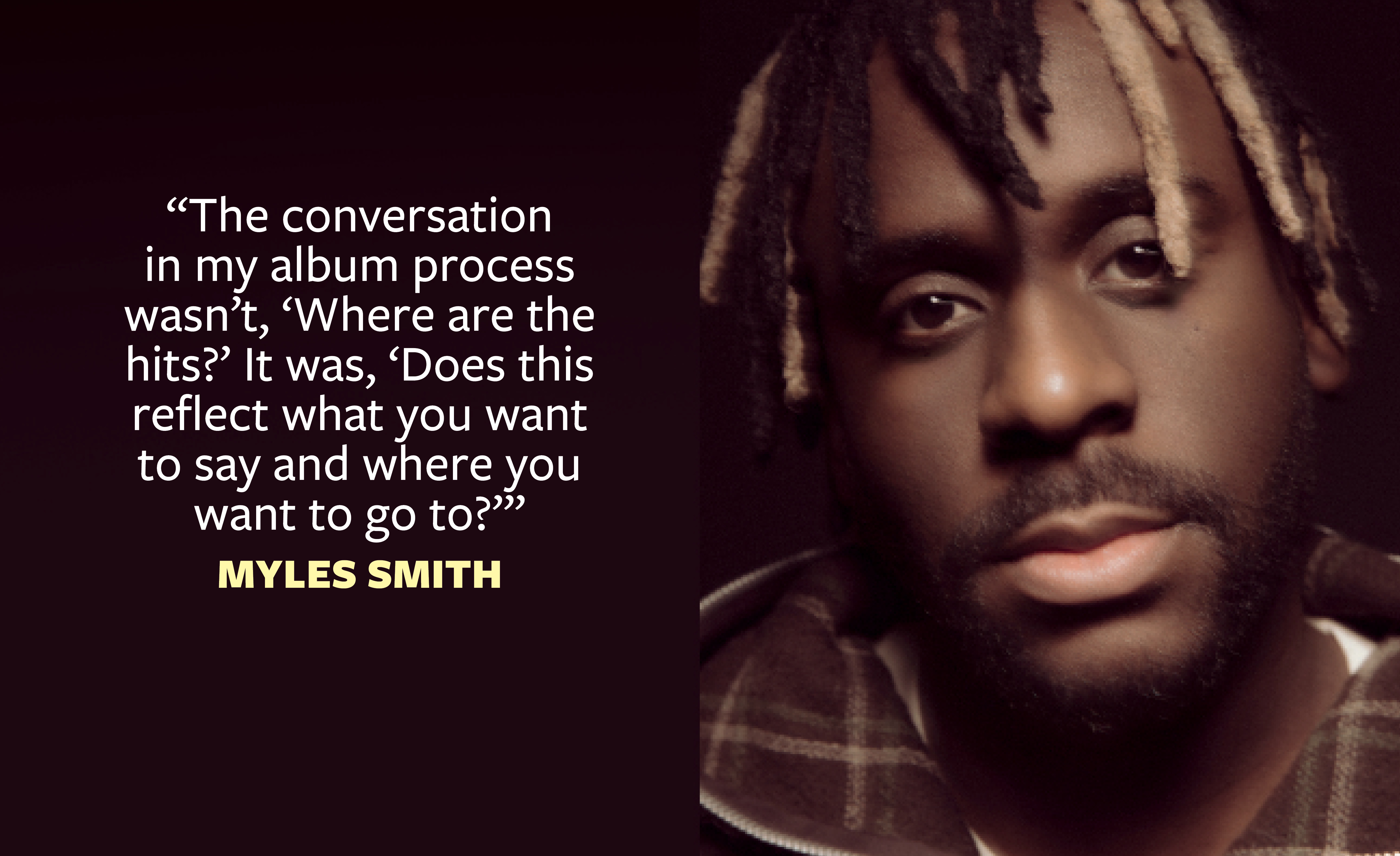
“The conversation in my album process wasn’t, ‘Where are the hits?’” he says. “It was, ‘Does this reflect what you want to say, and is this relevant to your journey as an artist as to where you want to go to?’ If it ticks that box, they’re behind it.”
“This album is the first time you really see Myles in full,” opines Glyn Aikins, who says he speaks to Smith most days and enjoys their “constructive debates”.
“He’s a very bright and intelligent young man who is always coming up with new ideas and approaches,” Aikins adds. “The world met him through Stargazing and Nice To Meet You, but this album shows the depth behind those moments. There’s a level of intention which shows that he understands himself as an artist in a way maybe he didn’t 18 months ago.”
Since Smith’s last Music Week cover, there has also been a switch-up in his management team, with his day-one duo of Extended Play Music Group’s Eric Parker and Paul Jeboda being joined by Closer Artists (George Ezra, Snow Patrol) pair Ryan Lofthouse and Paul McDonald, as well as Kirsty Richardson as day-to-day manager and Selina Barnow as head of marketing.
“It’s been amazing to grow the team,” says Smith. “We needed help in order to be able to build this global thing that we’re trying to achieve, while also bringing in people who share our values.”
“When you have a global hit followed by another global hit, you tend to be in very high demand and the pressure on the artist becomes exponential,” says Parker. “I decided I wanted to build a team around Myles that was very much tailored to him. I think that having a team who has been here before, who also are a steady pair of hands and great people, especially when we are playing arenas for the first time, has been very helpful. The best teams are those where it’s not about one person who’s some genius or who knows everything.”
The team-up made sense, says Closer Artists co-MD Lofthouse, who had already met Parker.
“It was like, ‘We’ve got a ton of experience, you’re flying, so let’s see if by combining your enthusiasm and momentum with us in the background in an overarching, strategic, campaign-based role, we can add some value to it.’” he says. “I think our reputation is for artists who maintain credibility and have careers beyond their supernova and viral moments.”
Closer is also helping internationally, Lofthouse adds.
“Stylistically, all of our artists had come from a similar place to Myles and we knew the lay of the land in all these territories and how much time was needed in each one. We helped sift through it and make the diary more efficient.”
As far as artistic collaborators go, though, there have only been a few minor tweaks. The album’s executive producer, Peter Fenn, is, explains Smith, his “main guy, who’s been with me since the start”. Alongside Fenn are Steph Jones and Jesse Fink, people he says are more than just fellow songwriters.
“They’re friends and they understand me as Myles the person, not the artist,” he states. “To restart that relationship could be a difficult task.”
Not that he was totally averse to it. Smith worked with Niall Horan on Drive Safe, whilst a team-up with the Nashville-based writer/producer Gabe Simon (Noah Kahan), resulted in three songs, including poignant standout Grandma’s Place.
“I find it difficult to open up to people I don’t know, but Gabe is really good at letting the artist do what they do best and knowing when to complement it or help steer,” Smith explains. “That was unexpected because I was so closed off to working with anyone new.”
“Myles is a great songwriter and that’s at the core of his approach to his A&R,” states Glyn Aikins. “He certainly has those people he regularly works with and part of this has been about keeping that core team to develop and grow and challenge themselves to write better songs, which is what they have done.”
RCA UK A&R director Joe Iddison is equally confident that the record will connect.
“The challenge in this market is it’s largely a track-based market and there’s a lot of noise on short-form platforms,” he offers. “The key for Myles has been to release music consistently and build genuine fan connection. To do that, you need a catalogue of songs that mean something to people. We’ve released three EPs and several collaborations so far, and that’s helped build a global fanbase who are now ready for a debut.”
Perhaps the most crucial production credit on the record is Smith’s own – he is listed as co-producer on every track. Smith is warm and friendly, a good talker who is reluctant to swear and at one point apologises for using the word “twat”. But, for someone so agreeable, somewhere in there is also an artist who knows when to put his foot down.
“As I get further into my career there is more noise, and more voices, so I want to be as close to the music as I can,” he says.
He is also, you sense, one of life’s natural fretters. The more success he has, the more anxiety he feels about it all.
“It’s like holding a piece of china you don’t want to drop,” he nods. “It’s a really daunting feeling.”
Perhaps these worries are the flip side of having such gargantuan hits before you’ve put out an album. That, Smith says, skewed things in establishing such a high precedent of success, but rather than let it cast a shadow over everything else, he tries to only see the positives.
“Having that success early on has given me the creative permission to be completely autonomous and have the trust of my label,” he points out.
“The focus has always been on building real fans,” says Aikins. “Whilst Stargazing changed everything, it doesn’t define him. It’s the thing that opened the door, and all of the music we’ve released has been in service of helping him build a fanbase.”
When Stargazing came out, Smith followed the streaming numbers religiously, but he quickly realised that wasn’t a sustainable way to make art.
“I care more about going into rooms and playing live music and thinking about how I make people feel,” he says. “I never got into this to have plaques on my walls or to say that I’m No.1 on radio here or there. I got into this because music helps me communicate how I feel.”
Ed Sheeran, who knows a thing or two about following up a huge hit, offered some advice.
“He said, ‘Don’t sweat it – if you were an artist that was going song to song, then I can see why you’re putting this pressure on yourself, but you’re building a career,’” Smith recalls, adding that Sheeran said any career, whether his own or Elton John’s, would go up and down.
“He said, ‘You’re going to have low moments and moments that peak, and you just have to take all of them in your stride,’” Smith recounts. “If you put success down to numbers or milestones or statistics, it’s gonna be an endless game of being happy and disappointed. For me, it’s about, ‘Am I content in what I’m doing, am I being authentic and honest with myself, and am I making myself proud?’”
Smith and Sheeran have become fast friends. Smith says their attitude to life is similar, and Sheeran tells him that he reminds him a lot of himself.
“Obviously less ginger and darker in complexion,” he adds. “He didn’t come from much either, but I think at the heart of it is that we love making music. I have no interest in fame; it’s not something I’ve ever been hungry for. It’s always about how music can be the most important and defining part of my career, and I think he sees that in me.”
Smith puts his finger on why the pair have such a firm bond.
“We’ve clicked because we connect as human beings, not as musicians,” he says. “When I spend time with him, it’s about, ‘How’s the family? How’s life? What are you up to?’ It’s never about, ‘How’s your career?’ For him, I think it’s probably nice having another person in his life who’s concerned about Ed the father, the husband or the friend, rather than Ed the global success. We connect as human beings.”
Smith certainly belongs in the artistic lineage of Sheeran, in that his songs are deeply rooted in a sense of normality. It is imbued in his music and who he is.
“Without it sounding like an X Factor story, I genuinely do come from not a lot,” he says. “I grew up in a working-class town. We fought a lot when it came to my upbringing, and I was on free school meals. Not having to worry about rent and bills is already a privilege, and every time I go back to Luton I have to remind myself where I came from.”
He was back there recently to play a surprise acoustic show outside The Hat Factory, a venue where he cut his teeth. For Smith, grassroots venues are the lifeblood of British music.
“If I hadn’t played a thousand shows before I went on my first headline tour, I don’t know what sort of artist I’d be,” he states. “I don’t know if I’d have the skills to do it.”
He is aghast at the work owners and artists need to put in to keep such venues alive, lamenting the “lack of infrastructure and lack of funding”.
Smith says he’ll do his bit for the cause where he can, while Craig D’Souza, partner at Smith’s booking agent WME, stresses that the singer is “super conscious about ticket prices and ensuring his shows are accessible to all”.
“There are things that we’re planning for in our future touring to support that,” Smith says. “And I’ve done some regional bits with Amazon to help music centres and projects supporting grassroots avenues into music. For me, raising awareness is key, raising capital is key, and so is continuing to have conversations with gatekeepers of funding in our country and beyond to make tangible changes.”
There were a number of offers when it came to signing a record deal, but Smith went with RCA after meeting Aikins, Tang and Iley.
“We just connected as people,” he remembers today.
“Jason said, ‘I will be your champion, I will back you no matter what from the start’, and that has not changed,” adds Eric Parker. “It’s rare to see someone like Jason constantly so involved in a project. He wants to know everything, and he does know everything.”
Smith has gone on to become the banner success for Tang and Aikins’ tenure at RCA UK, which began in February 2023.
“In terms of us taking over [at the label] to him being the first artist to break globally, it’s definitely been a flagship success,” notes Aikins. “It keeps us all focused on building on that and taking learnings from it in how we develop artists.”
Aikins thinks that success for Smith’s new record would be consolidating the global reach he has achieved so far and laying the groundwork for future albums. There is no trick to growing the fanbase, he says – it’s all about consistently releasing great songs.
“They don’t necessarily all have to be big hits,” he adds. “But that, along with live, is the backbone of establishing the narrative of being an artist.”
Craig D’Souza predicts further growth.
“Myles has all the right attributes to be a stadium or festival headline artist,” he tells Music Week. “He has talent, ability, understanding of the steps needed, attention to detail in his craft and work rate. No one can say they want it more for Myles than he wants it for himself, which is absolutely the right way round.”
Aikins also highlights the importance of maintaining and growing his global fanbase by targeting specific territories.
“Germany, for example, is a really big market for Myles, which he keeps revisiting,” he explains. “Scandinavia and France are also examples of where his music has really resonated and he keeps going back. Of course, there’s America as well, which has seen a lot of success. You need to be committed to spending a lot of time there if you want to build on any success you achieve, which Myles is doing.”
On the management side, the approach is based on a balance between being innovative in digital strategy in how they reach fans, while ensuring that Smith can be himself.
“That might be the most important thing,” says Parker of the latter point. “When there’s so much pressure as a result of success, it’s really easy for an artist to succumb to that change.”
You could say the stage is perfectly set for Smith, with the likes of Olivia Dean and Sam Fender raising the ceiling for what UK acts can achieve, but Aikins offers a counterpoint.
“I’d argue Myles came at the beginning of that wave, particularly with Stargazing, because everything seemed to come after that,” he declares. “He’s firmly part of the renaissance of big, successful British artists. Of course, we’ll take the learnings from other success stories, as I’m sure they are taking from his.”
Aikins thinks that what RCA has done well is shown patience and focused on artist development, maintaining the ambition that British music is always of interest in most parts of the world.
“An artist like Jade is another success story on that level,” he says. “We’re building the roster, particularly where new music is concerned, so that it can benefit from that. You want everyone else to take confidence that this is actually possible.”
Myles Smith’s first break arrived when he became a viral sensation via various covers, but these days he says his relationship with social media is a “strange one”.
“TikTok is an incredible tool for artists to find their community,” he says, citing Sienna Spiro and Bella Kay as key examples of this. “My personal relationship with it has changed a little bit in that I always want to use it for what I loved it for – and that’s finding a community – but there’s also the pressure that it’s a marketing tool. There’s such a dichotomy in my brain. I don’t want to feel like I’m having to market myself, but there’s also the reality of being an artist at the level I am that you have to. I’m in a grey area with it.”
He was never much inclined towards social media before being an artist (“I tend to live and exist in the real world,” he confides), but he accepts that it is a big part of the promo cycle.
For all the love Smith has received online, though, there will always be a flip side. He thinks he’s been quite lucky on the whole – “I don’t think I’m a very polarising character,” he muses jovially – but he has had to deal with online abuse.
“The difficulty will always exist in that I’m a Black artist, and a lot of people view the music I make as not [typically] associated with Black artists – although one history lesson will teach you otherwise,” he says. “When you’re pushed to an international market, and some markets aren’t as progressive and liberal as we are in the UK, you deal with a lot of racism. It’s part of my experience of being online. It blows my mind, but I’ll get monkey emojis and the N-word in my DMs and a slew of comments that I know my team work hard to get rid of – but these things still exist.”
It has been “super difficult”, Smith explains, dealing with the idea that the music he makes isn’t of Black origin, so it felt particularly special when Nice To Meet You was nominated for Song Of The Year at the MOBO Awards this year. He also performed a stripped-back version of Stargazing at the ceremony.
“I’m a Black man of Jamaican descent,” Smith continues. “My grandparents came here during the Windrush generation and built a life – they’re my roots. So, to get that recognition from a Black institution was a really nice tap on the shoulder, to be like, ‘You’re being seen and what you’re doing is incredible.’ That, for me, was super important.”
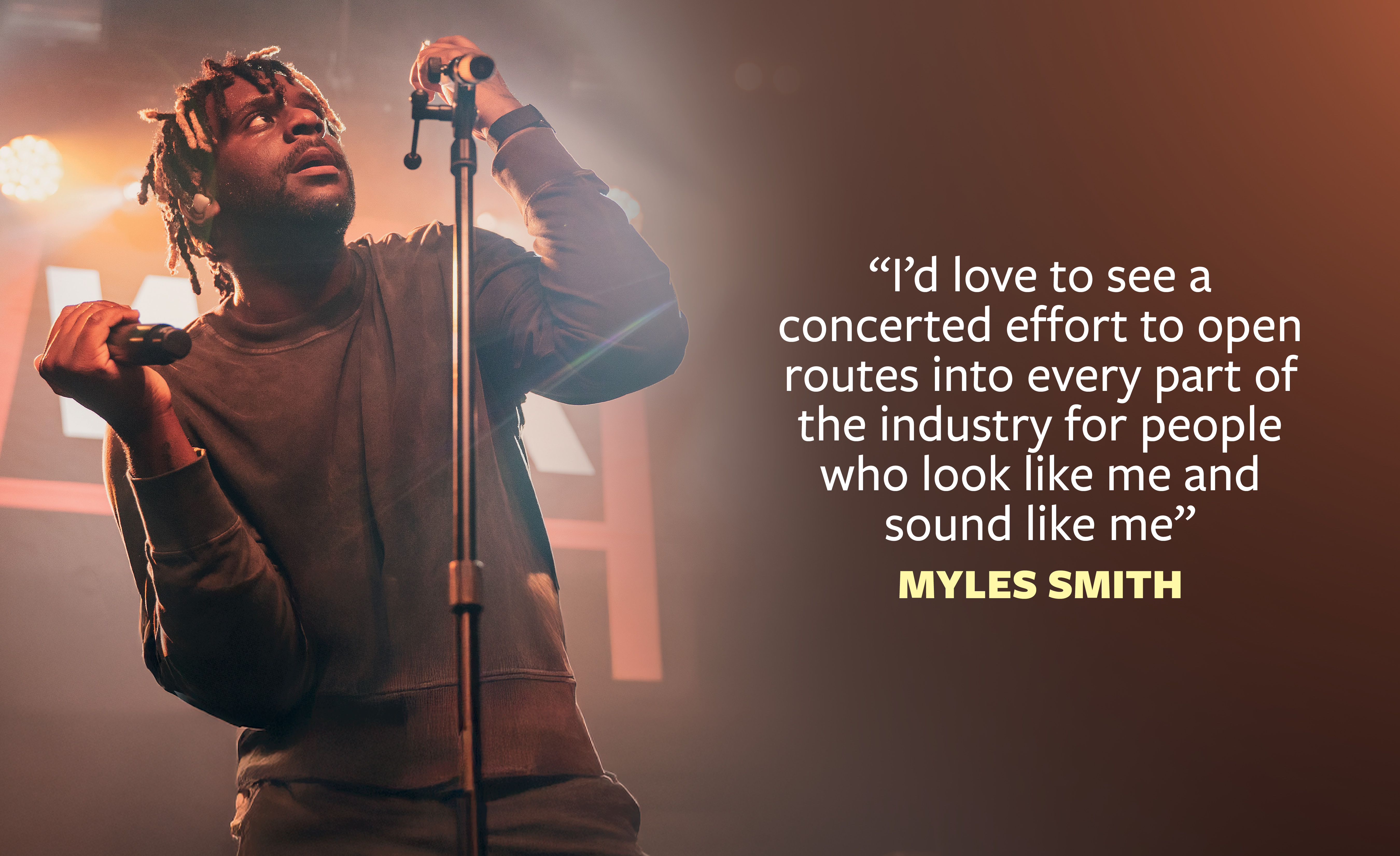
Smith says he wishes there were more accessible routes into the music industry for people “who look like me and sound like me”.
“I’d love to see more of a concerted, intentional effort into opening routes into the music industry,” he says. “And that’s not just as an artist; it’s in every line of the industry, whether you want to be an A&R, a manager or work in the touring business.”
Without his friends pushing him to keep going, or meeting his management, he thinks he wouldn’t have made it.
“I don’t think it should be this hard to get into music,” he says.
Smith has also worked with the Ed Sheeran Foundation, urging the government to find ways to improve access to the industry for people from a working-class background.
“It shouldn’t be on us to be championing change; the arts should be a priority,” he insists. “It is one of our biggest cultural and financial exports, so I can’t fathom why it’s taken so long to understand that.”
This is as close as this impossibly upbeat singer-songwriter gets to sounding slightly miffed. Smith has had a meteoric rise, but the way he describes it, this is only the start of the climb.
By the end of the year, he’ll officially be an arena artist.
“I like the ring to that!” he beams as we part ways. “Holy shit, I guess I am an arena artist. Honestly, if you strip away everything, my dream was always to stand on the stage and play music and be able to live on it. I love writing and recording, but playing live is the thing I love the most. It feels like a fever dream…”