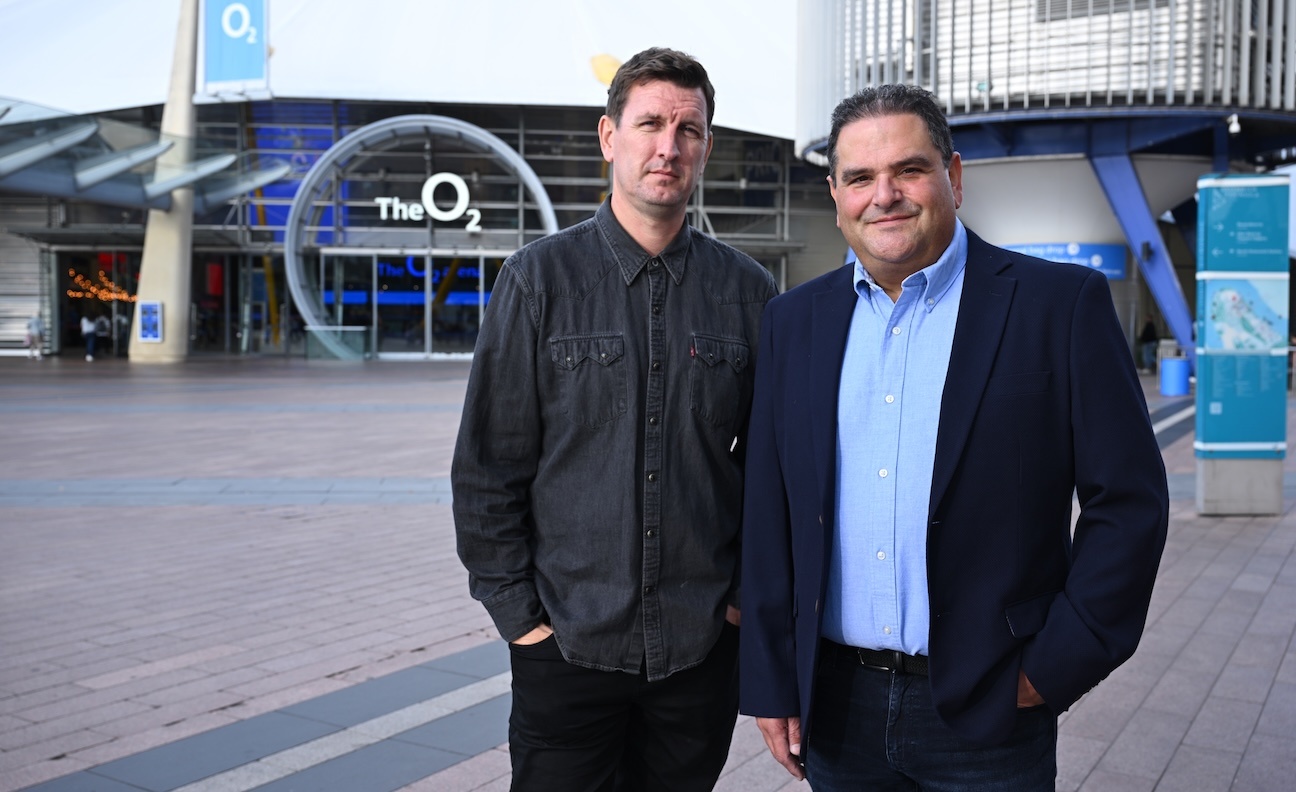
AEG International’s Paul Samuels and Virgin Media O2’s Gareth Griffiths have spoken to Music Week following the announcement of a 10-year extension to The O2’s long-standing naming rights deal.
O2 will retain naming rights to the AEG-owned and operated London venue until 2038, in what the companies describe as the largest naming rights renewal of its kind in UK history.
Since opening in 2007, The O2 has welcomed more than 100 million visitors and hosted over 6,800 events. The partnership has also seen a number of high-profile activations, including temporarily renaming the venue ‘The O3’ during Drake’s seven-night residency in 2019 and creating a digital recreation of The O2 within Fortnite.
Paul Samuels, AEG International president – global partnerships, secured the original naming rights deal when at O2 and has continued to oversee the partnership in his role at AEG.
“You have to remember The O2 was the old Millennium Dome,” says Samuels. “People said it would never work, but O2 and AEG partnered up and created this amazing experiential space. Last year we did 239 shows and next year there will be even more shows. It just goes from strength to strength.”
As part of the new agreement, O2 and Virgin Media broadband customers will also gain Priority access to shows at Indigo At The O2 for the first time. The deal will increase the number of tickets available through Priority Tickets by 50%.
“Indigo feels like a real sleeping giant,” says Gareth Griffiths, director of partnerships and sponsorship at Virgin Media O2, who defines the alliance with AEG as a “genuine value exchange”.
“The O2 has been the backbone of the growth of Priority Tickets,” he continues. “When it started in 2007, we sold maybe 70 Priority Tickets for a show that week. Last year, we sold 1.7 million.”
The announcement comes as The O2 prepares to celebrate its 20th anniversary in 2027, with concerts by acts including Maisie Peters, Jorja Smith, David Guetta, Kings Of Leon and Sombr already lined up for its birthday series.
In the following Q&A, Samuels and Griffiths look ahead to the next decade, discuss the impact of the BRITs moving to Manchester and reveal how Drake ended up with The O3 sign in his basketball court...
How significant is renewing this partnership for both companies?
Paul Samuels: “We're very excited. We celebrate our 20th birthday next year and it's great to be able to extend the partnership for an additional 10 years, which will take us to 30 years.”
Gareth Griffiths: “It's been an amazing partnership, so we're so delighted to extend it through to 2038. The O2 has been such an important brand asset for us, and also for our customers. When we look at the visitor numbers, O2 customers massively over-index.”
What made it the right call to deliver this scale of commitment right now?
GG: “It was important to show that long-term commitment to the venue and to our partners in AEG. It's a big sign of intent. You also get better value for money the longer the contract is.”
Why do you think the partnership has been so successful, to the point where people barely still think of it as a naming rights deal?
GG: “It's a very iconic looking building for starters. The Dome was infamous, and what happened to it next was always going to be in public interest. When O2 stepped in, it was a very brave move, but it was a huge success straight away. When we were looking at the business case for the renewal, 96% of the UK had heard of The O2, which is astonishing. When you think about the actual reach and awareness of a brand through naming rights, it’s unprecedented. We've sold over 3.9 million Priority Tickets to our customers [since 2007]. Music's right at the core of the O2 brand. Certainly, post Covid, we've seen that people have realised how important the live experience is to them. And there’s continuing to be a real explosion in the live experience off the back of Covid.
“It helps as well that we were at The O2 from the very start. We were the founding partners – the name above the door. We've been part of the fabric for the venue right from the word go. I'm biased, of course, but O2 is a very cool brand. They've got an amazing venue. That's a pretty good formula for a long-term partnership.”
PS: “The arena itself takes up 45% of the floor space, but with the outlet mall, restaurants, bars, leisure activities, Mamma Mia! The Party, Indigo At The O2, there's so much around it. The development and investment that AEG keeps making into the venue keeps it as number one.”
What can fans expect to see differently from this partnership over the next few years?
GG: “If you're an O2 customer, there'll be even more opportunities to buy tickets. And if you go into the arena bowl now, you've got O2 5G [DAS mobile network]. The connectivity in the arena is absolutely first class.”
PS: "The presale window works so well for promoters and fans, it's amazing. The reason the majority of shows now go on sale on a Wednesday is because O2's presale starts on Wednesday. Promoters are choosing their on sale dates based on when the O2 presale mechanic works on their systems."
It was important to show that long-term commitment to the venue and to our partners in AEG. It's a big sign of intent
Gareth Griffiths
Where do brands most often get it wrong with naming rights?
PS: “Naming rights is not sticking a logo on a building. It's how you activate, the benefits you give your customers, how you really bring the naming rights to life. It shouldn't be a badging exercise. You might get the exposure, but you're not getting a real return on investment. Whenever we're selling naming rights around the world, I reference the O2. We bring people to The O2 to show them how it's done, and they always walk away going, ‘Okay, I get it now.’ This is our global case study.”
Paul, you're the person who named The O2. How did you come to that decision, and how difficult was it to get over the line?
PS: “It was the hardest thing I’ve ever had to get over the line through my career. Hopefully there’s nothing in the future that’s going to be even harder! I remember getting a phone call when I was working for O2 asking if we wanted to sponsor the Millennium Dome, and I said, ‘No thank you,’ and put the phone down because the Millennium Dome was a public disaster scene – a white elephant that people just laughed at.
“But then I think AEG realised no one knew who they were, so they basically decided to create a trip to Vegas and LA to show us their properties in the US. I went on the trip and was inspired by what a proper live experience was. So I came back to O2 and said we should stop sponsoring Arsenal – a team I love – and put our money into something completely different. The CEO thought I was crazy and kicked me out of his office.
“I was lucky. There was a lady called Cath Keers, who was the marketing director at the time, and I kept pushing her. She said, ‘Look, if you want to spend a bit of money doing some evaluation work on it, go ahead.’ So I started evaluating and understanding naming rights. I worked with an agency in America who specialised in this to evaluate what this could be, and then went back to the board.
“Thankfully, the CEO who kicked me out of his office had left. The new CEO was the ex-CFO. He actually got it and said, ‘You should start negotiating with AEG. But you’ve still got to get it signed off by the PLC board.’ We had to take it to the PLC board three times because each time they kept saying no. It got to the stage where I think I just stalked them so much that they had no choice.
“The reason O2 were so nervous, which I didn’t know at the time, is that they were looking to sell their business to Telefónica and didn’t want a multi-million-pound failure sitting on their books. But, thankfully, we’re here now 20 years later, and talking about taking it to 30 years because it has been a great success. Everyone said, ‘No one will ever call it The O2, it will only be known as the Dome.’ Yet within months, everyone was calling it The O2 and it’s now the number one music venue in the world.”
The O2 hosted the BRIT Awards from 2011-25. With the BRITs heading up north this year, was that a blow to the value of the O2 brand, or is the breadth of the programming so much that individual events are less important?
PS: “The BRITs is a great event, and it's great that other parts of the country have the opportunity to have it. When the BRITs come to The O2, it takes a lot of days out of the calendar – not just the event itself – the whole build-up can take seven to 10 days. So when you get 10 days back from your calendar, it means you can bring more shows in. Look at our programming for the last year, we had more shows than ever before, so it's great for us. If it comes back one day, then that's brilliant as well, but The O2 doesn't rely on one particular show.”
Co-op Live has come along in Manchester and created a lot of headlines. Has that made you approach anything differently?
PS: “It's a beautiful venue. We don't see it as competition. We're still the number one music venue and hopefully always will be. We're fortunate to be in London, but we actually see ourselves as a national venue. We don't see ourselves as a London-based venue. We've just come off the back of Ariana Grande doing 10 nights in London. That was not just a UK show; that was a European show. It was the only show she played outside the US. We've seen that since Prince did 21 nights when we started. We created this residency model, and that keeps growing.”
Everyone said, ‘No one will ever call it The O2, it will only be known as the Dome.’ Yet within months, everyone was calling it The O2
Paul Samuels
What opportunities do those residencies open up from a brand partnership point of view?
GG: “It puts The O2 on the news agenda, and the amount of social buzz we get off the back of it as a brand is fantastic.”
PS: “There's a famous Drake song [God’s Plan], where he talks about turning The O2 into The O3. We worked very closely with O2 at the time, and basically changed the name of The O2 to The O3. For that residency, we took the sign off the front and put an O3 sign up. It became the ultimate place for people to have selfies. Even Drake himself came out and had a selfie. He loved it so much, he asked to keep the sign afterwards. Actually – we've seen it on YouTube – he has The O3 sign hanging in his basketball court. If, when I put the business case together for O2 to sponsor The O2, I'd said, ‘By the way, a global artist is going to refer to you in their song,’ no one would ever have believed that.”
GG: “That's a great example of how we work together, because the actual idea came from someone in our social team. She said, ‘Why don't we change the front of the venue?’ So I had to go and speak to my CEO, and he loved it, and then we spoke to AEG. During the show, Drake shouted that line, ‘Turn the O2 into The O3’ and the place just went berserk. So great partnership, great idea and great activation. We love doing creative stuff like that. It makes you very culturally relevant at that particular moment in time, which for a telco is amazing.”
Gareth, regarding supporting emerging artists, what can you say about that commitment from O2?
GG: “We feel hugely passionate about emerging artists. Next year, we'll have 23 venues across the country – 22 O2 Academy venues ranging from a 500-capacity back room in Oxford, right through to O2 Academy Brixton – and then of course The O2. We want to make that a real opportunity for up-and-coming artists to come through. Sienna Spiro is one example, or Sombr, or Dua Lipa, where they start at an O2 Academy venue, and you see them grow around the country. Without the artist, there is no stage.”
Given O2’s long-standing campaign against ticket touting, how encouraged are you by the progress towards legislation?
GG: “We're very hopeful that there are going to be new laws soon. It feels like it's been a long time coming, but there's a lot of positivity coming out of No.10 and the latest government. So fingers crossed. It's something we've been campaigning on since 2017. There's nothing more annoying for us than when we put a show on a presale and immediately see tickets appearing on secondary sites. First of all, it means that money is not going to the artist, but also that our customers are missing out on those tickets, so they’re not going to the intended place. We really need to see the government take action. We're very hopeful and positive, but until you see these draft bills and the laws actually are taken through, then it's not going to have the effect that we want. Action needs to happen now. There's still far too many fans getting ripped off every week from secondary ticketing websites.”
To finish, what are your ambitions for the next 10 years? What does The O2 need to do to maintain its position over that time?
PS: “There's two parts. As a venue, we need to keep investing, we need to keep updating. One of the biggest things we've seen post-Covid is the requirement for people to want a better experience. They're investing in premium tickets. Premium tickets used to be about corporate hospitality, but now it’s also individuals who just want to have that better experience. So it's important for us to keep refreshing what we're doing to stay ahead of the game, and we will continue to do that. Every time I walk into The O2, I still get that buzz and that chill down my back.”
GG: “The customer experience is a really big focus for us. We don't rest on our laurels at all. We're very proud of what's gone before, but it's actually quite rare that we talk about the past. I think a moment like this, where we're renewing a 20-year partnership for another 10 years, justifies that. But it has to be about what we're doing next. In our new agreement with AEG, we've got co-investment to make sure we still get the very best artists into the arena. We're co-invested in the digital experience, and there's investment on the capex side of the venue to make sure it continues to evolve. There's some really exciting stuff in the pipeline.”