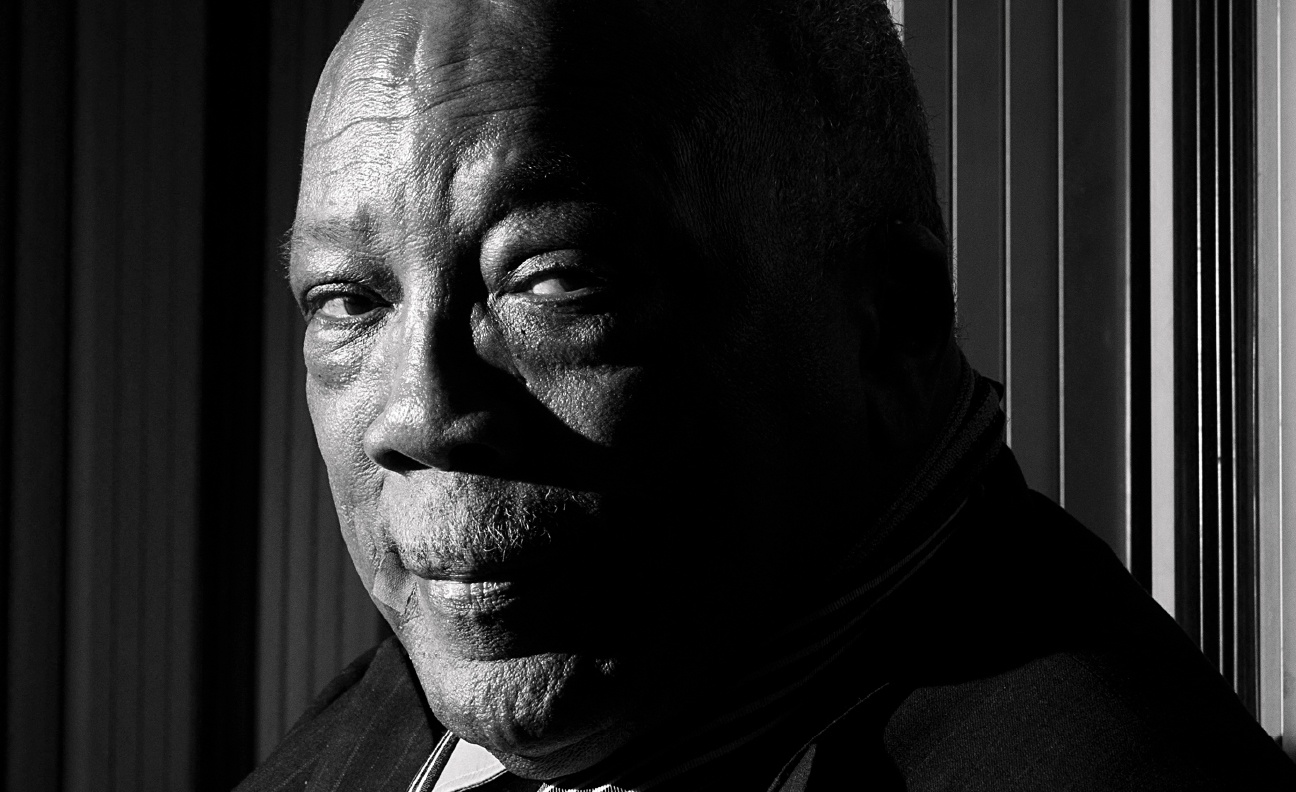
When the news broke that Quincy Jones had passed away at the age of 91, the music business mourned the loss of one of its most influential figures. The legendary producer, songwriter and musician worked with stars such as Michael Jackson, Frank Sinatra, Ray Charles and many more, while his achievements also included becoming VP at Mercury Records in the early 1960s and becoming the first Black musical director for the Academy Awards. Here, in a special obituary, Music Week reflects on his incredible career…
Words: James Hanley Photo: Joel Saget/AFP, Getty
No history book on popular music can be complete without a chapter on Quincy Jones. The peerless American producer, songwriter, composer, arranger and executive, who died aged 91 at his home in Bel Air on November 3, was a behemoth in a land of giants.
“With full but broken hearts, we must share the news of our father and brother Quincy Jones’ passing,” read a family statement. “And although this is an incredible loss for our family, we celebrate the great life that he lived and know there will never be another like him. He is truly one of a kind and we will miss him dearly. Through his music and his boundless love, Quincy Jones’ heart will beat for eternity.”
In an unparalleled 70-year career, the Chicago-born musician made his name in jazz as a trumpet player turned band leader, before earning legendary status as producer to icons such as Frank Sinatra, Miles Davis, Ray Charles, Aretha Franklin, Paul Simon and most famously Michael Jackson.
Within the industry, Jones broke down racial barriers in the US with his appointment as VP at Mercury Records in the early 1960s and in 1971, he became the first Black musical director for the Academy Awards ceremony.
“Quincy Jones was a musical genius who transformed the soul of America – one beat, one rhythm, and one rhyme at a time,” said US president Joe Biden. “Growing up as a child facing segregation and poverty, he found music to be a refuge. As a teenager, he trained with some of the greatest musicians ever. Over the next seven decades, he became a producer, composer, instrumentalist, executive, and so much more, discovering some of our most iconic artists and shaping the most memorable records and scores in history.”
Clive Davis hailed Jones as the “ultimate music renaissance man”, adding: “Whether it was jazz, pop, R&B or rock, no genre of music escaped his genius.”
Elsewhere, Paul McCartney praised him as “supremely talented”.
“His work with Michael Jackson is, of course, legendary and he had so many other strings to his musical bow,” said the former Beatle.
Jones produced Jackson’s Off The Wall (1979) and Bad (1987) records, but is best known for his work on Thriller (1983), widely believed to be the biggest-selling album of all time. As a producer, Jones helped Jackson bring together the hugely successful stew of pop, R&B, funk, disco and rock – including recruiting Eddie Van Halen for a guitar solo on Beat It. He was also credited as co-writer on PYT (Pretty Young Thing). Michael Jackson’s estate said the King Of Pop had “tremendous admiration for Quincy’s spirit and vision”.
“Quincy changed the course of popular music numerous times,” the statement continued, “widening its horizons and bringing his take on jazz, R&B and pop to the mainstream.”
In addition, Jones conducted and co-produced the 1985 charity record We Are The World, by the supergroup USA For Africa. Co-written by Jackson and Lionel Richie, its all-star line-up also included the likes of Stevie Wonder, Billy Joel, Tina Turner, Bob Dylan, Diana Ross and Bruce Springsteen.
Jones taped a sign to the studio door that read: “Check your ego at the door,” but he played down the statement decades later in a keynote address at Canadian Music Week 2014. “We didn’t need that sign,” he insisted. “It was overblown – those people came to give up their hearts.”
The EGOT (Emmy, Grammy, Oscar and Tony Awards) winner also gave his side of the story on why he and Jackson went their separate ways after three albums together, explaining that despite Bad’s sales topping 25 million, its commercial performance failed to meet the singer’s stratospheric expectations.
In terms of film and TV scores, Jones worked on soundtracks to more than 50 productions including Roots (The Saga Of An American Family), In The Heat Of The Night, The Italian Job and the Oscar-nominated The Color Purple, which he also produced. He was recognised with honorary Academy Awards and also received France’s Legion d’Honneur.
Warner Chappell Music co-chair & CEO Guy Moot and co-chair & COO Carianne Marshall added to the tributes.
“We mourn the loss of the great Quincy Jones, and celebrate his immeasurable contributions to culture,” the pair said in a statement. “Words like titan, genius, GOAT, will be used and he deserves it all. Quincy was a producer, artist, composer and activist, but above all, he was a songwriter. He leaves behind an extraordinarily powerful, diverse body of work that will light the way for future generations.”
Jones co-wrote for artists including Donna Summer, Dizzy Gillespie, Rufus & Chaka Khan, Peggy Lee, Queen Latifah, Lesley Gore and Andy Williams. He won a remarkable 28 Grammys, along with a Recording Academy Trustees Award in 1989 and a Grammy Legend Award in 1992.
“Anybody who says they know what a record’s going to do is lying; you just make the record that moves you,” asserted Jones back in 2014 at his Canadian Music Week keynote. “You have to do what comes from the bottom of your soul and what you believe in and gives you goosebumps.”
In 1990, he formed Quincy Jones Entertainment, in partnership with Time Warner. TV projects included The Fresh Prince of Bel-Air, produced by Jones, which set Will Smith on the path to stardom. The company was sold for $270 million in 1999. His ventures also included Qwest Records and Qwest Music Publishing.
“My philosophy as a businessman has always come from the same roots as my personal credo: take talented people on their own terms and treat them fairly and with respect, no matter who they are or where they come from,” he wrote in his 2001 memoir, Q: The Autobiography Of Quincy Jones.
Jones also became co-producer of Switzerland’s Montreux Jazz Festival in 1991, a role he carried out for three years alongside its founder Claude Nobs.
“This collaboration opened with a masterstroke: they managed to convince Miles Davis to revisit major works from his past in Montreux – a feat he had always refused until then,” recalled the festival in a statement.
Inevitably, the live recording – Miles & Quincy: Live at Montreux – won a Grammy – this time for Best Large Jazz Ensemble Performance. Jones, who was married three times and had seven children, performed at London’s The O2 in 2018, alongside special guests for the show Quincy Jones: A Life In Song. A Grammy-winning film, Quincy, was released the same year, co-written and co-directed by Alan Hicks and Jones’ daughter, Rashida Jones.
In his aforementioned 2014 Canadian Music Week address, Jones surmised that, ultimately, success in music can always be traced back to the songs.
“A great song can make the worst singer in the world a star,” he explained. “A bad song, the three best singers in the world can’t save it. So when you get a good singer and good songs, you’ve got a good shot.”